Humanoid Robot
Platforms
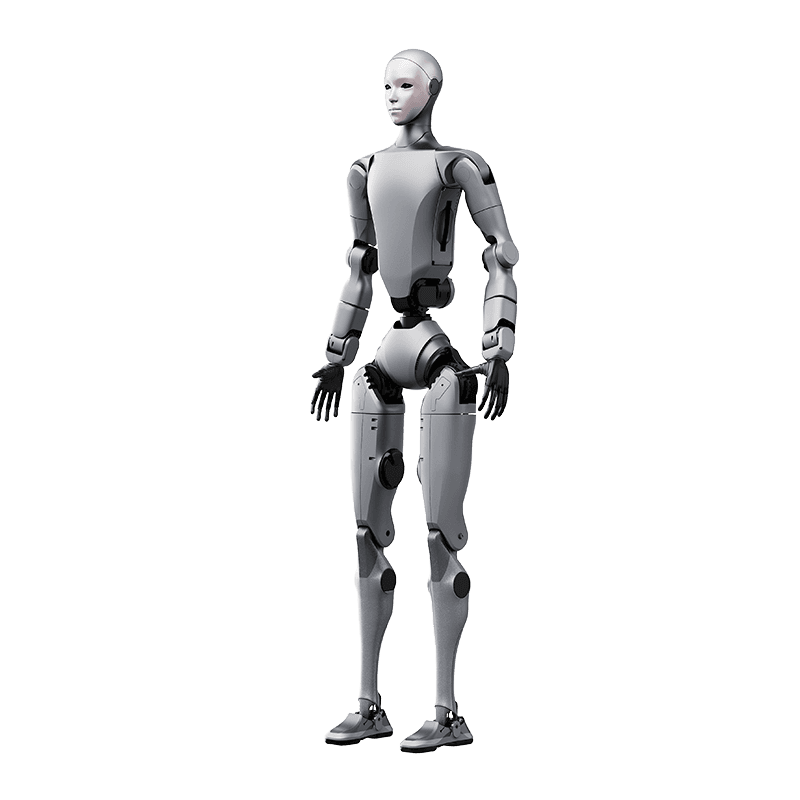
The world's most advanced bipedal humanoid robot systems, Unitree G1 and H2. Designed for industrial automation, AI research, and hazardous field operations.
What is a Humanoid Robot?
A humanoid robot is an autonomous or semi-autonomous system designed to resemble the form and mobility of the human body. Thanks to their bipedal walking capabilities, they can easily operate on stairs, rough terrain, and human-centric facilities where wheeled robots cannot reach.
Powered by advanced Artificial Intelligence (AI) and machine learning models, next-generation humanoid robots do more than perform physical tasks; they analyze their environment with 3D LiDAR and depth cameras to make autonomous decisions.
Embodied AI
AI that understands the physical world
Precise Manipulation
Multi-finger dexterous hand systems
Industrial Strength
High-torque joint motors
Safe Operation
Standards for working alongside humans
Watch Humanoid Robots in Action
Discover the autonomous mobility, environmental perception power, and durability of the Unitree G1.
Humanoid Robot Technology: A Comprehensive Guide
The engineering evolution from automatons of the past to today's AI-powered bipedal systems.
History & Evolution
The concept of humanoid automatons emerged in the 4th century BCE in Greek mythology (Hephaestus' inventions) and Chinese philosophical texts (Liezi). In the 13th century, Al-Jazari's water-powered mechanical servants and Leonardo da Vinci's 15th-century pulley-operated armored robot laid the foundation for modern robotics.
Today, pioneering companies like Unitree are turning this historical vision into reality by replacing ancient mechanical gears with AI chips capable of trillions of operations per second (TOPS) and LiDAR-based environmental perception systems.
Sensors & Perception
A humanoid robot's understanding of the world relies on two main sensor groups: Proprioceptive (Internal) and Exteroceptive (External) sensors. IMUs (Accelerometers and Gyroscopes), working much like the human inner ear, maintain the robot's balance.
To perceive the outside world, systems like the Unitree G1 use LIVOX 3D LiDAR and Intel RealSense depth cameras (Computer Vision). These systems map stairs, obstacles, and objects to be manipulated with millimeter precision.
Actuators & Musculature
Early humanoid robots (such as older Atlas models) used hydraulic systems to generate massive power. However, the maintenance difficulty, weight, and leak risks of hydraulic systems pushed the industry in a new direction.
Today, Unitree uses industry-defining electric Brushless PMSM (Permanent Magnet Synchronous Motor) technology. This allows a robot like the H2 to achieve a massive 360 N·m of joint torque entirely electrically, silently, and with zero leak risk.
ZMP & Whole-Body Control
Bipedal walking is one of the most complex problems in robotics. To remain balanced, humanoid robots constantly perform 'Zero Moment Point' (ZMP) calculations.
When carrying a load or colliding with an object, 'Whole-Body Control' algorithms step in to prevent falling. These algorithms simultaneously coordinate the robot's arms, torso, and legs to absorb energy and prevent a fall.
Unitree Humanoid Robot Models
Platforms designed for every scale of need, from education to heavy industry.

Frequently Asked Questions about Humanoid Robots
What is currently the best humanoid robot?
Depending on the use case, Unitree G1 and H2 series are considered among the best humanoid robots in the world in terms of price/performance, AI integration, and accessibility. Notably, the H1 model holds a world speed record.
How much is a humanoid robot going to cost?
While humanoid robot prices used to reach millions of dollars, modern mass-produced models like the Unitree G1 have made them far more accessible; in Turkey the G1 starts at $36,000 with authorized distributor pricing. Industrial models can range between $50,000 and $150,000.
Can we buy humanoid robots?
Yes, humanoid robots are no longer just for research labs. You can purchase commercial humanoid robots like the Unitree G1 and H2 immediately through Robotlar.org with official Turkey distributor warranty.
Can a humanoid robot clean a house or cook?
Today's robots like the Unitree G1, thanks to 'Embodied AI' and multi-finger dexterous hands (Dex3-1), can learn complex manipulation tasks such as cracking walnuts, soldering, and holding pans. Full autonomy in household chores is expected in the future.
What is the lifespan of a humanoid robot?
Robots produced to industrial standards can serve for years with regular maintenance and software updates. Unitree robots offer easy part replacement due to their modular hardware and receive OTA (Over-The-Air) updates.
Invest in Humanoid Robot Technology
Consult with our expert engineering team to determine the most suitable humanoid robot configuration for your company's needs.