Why the Comparison Has to Be Mission-Based
Ground robots and drones are often presented as alternatives in security patrol, but they operate under different constraints. The drone's advantage is speed of access and altitude; the ground robot's advantage is endurance, payload budget and independence from weather. The right question is not which is better, but which constraint your site actually runs into.
Endurance: Hours or Minutes
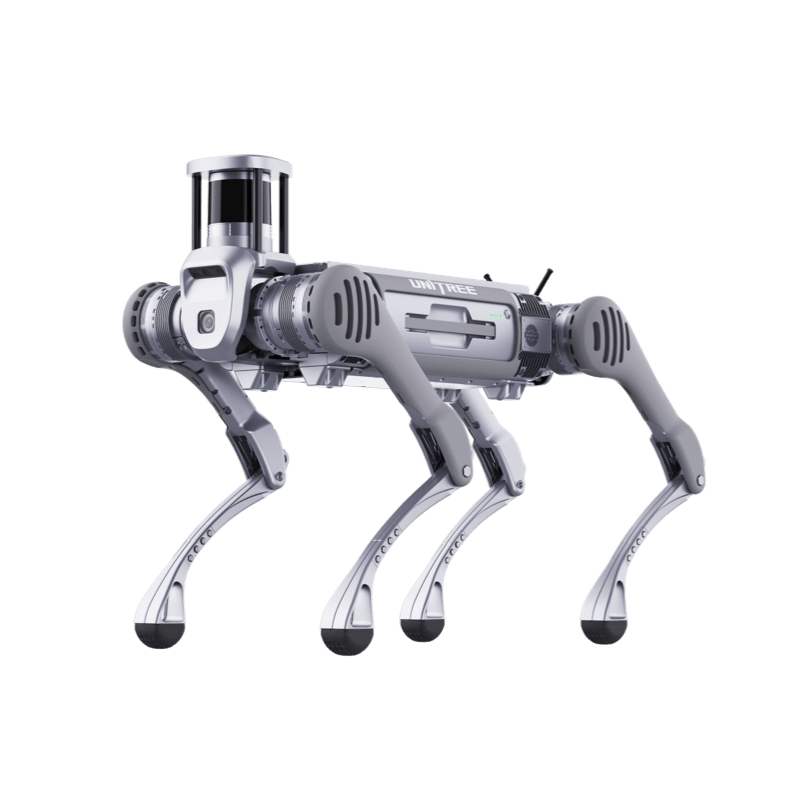
This is the largest split. The Unitree B2 patrols for over 5 hours unloaded and over 4 hours with a 20 kg load from its 2250 Wh battery. A typical commercial multirotor stays airborne for tens of minutes on one battery and needs a swap after every round. To cover an eight-hour shift without interruption you have to plan a battery rotation and the staff to manage it on the drone side; one or two swaps are enough on the B2 side.
Weather, Regulation and Noise
Drone operations depend directly on wind, precipitation and visibility; commercial UAV flights in Turkey also fall under the civil aviation authority's registration and permission framework, and restrictions on flying over populated areas shape the operational plan. With IP67 protection and a -20 to 55 degree operating range, the B2 works in rain and dust, needs no flight clearance and can enter enclosed and underground spaces. Noise is another practical difference: rotor noise is a problem at most sites during night patrol, while a ground robot can patrol quietly.
Payload and Sensor Budget
The B2's 40 kg walking payload covers a thermal camera, a gas sensor, a speaker and a spare battery pack at the same time, with a 120 kg standing capacity. On a drone every 100 grams comes out of flight time, so sensor selection is a tight budgeting exercise. For inspections needing multi-sensor fusion, such as thermal anomaly, gas and imagery in the same round, the ground platform has markedly more headroom.
Access: Where the Two Genuinely Diverge
There are two scenarios where the drone is unambiguously better: sweeping a wide area quickly and seeing assets at height. Chimneys, roofs, the tops of pylons and a bird's-eye sweep of a large storage yard are drone work; the B2 cannot get there. Conversely, stairs, narrow corridors, covered car parks, tunnels and underground galleries are ground-robot territory, where a drone either cannot fly or loses its positioning signal.
In Practice the Best Setup Is Usually Both
At large sites the two platforms complement rather than compete: the drone sweeps the perimeter and high points periodically, while the ground robot covers building interiors, tunnels and the night shift with continuous patrol. If the budget stretches to only one, return to the constraint question: a mostly vertical, wide-open site favours the drone, while a mostly horizontal, enclosed site with long shifts favours the B2. We can settle which setup fits your conditions with a free site survey.