What Does the Video Show?
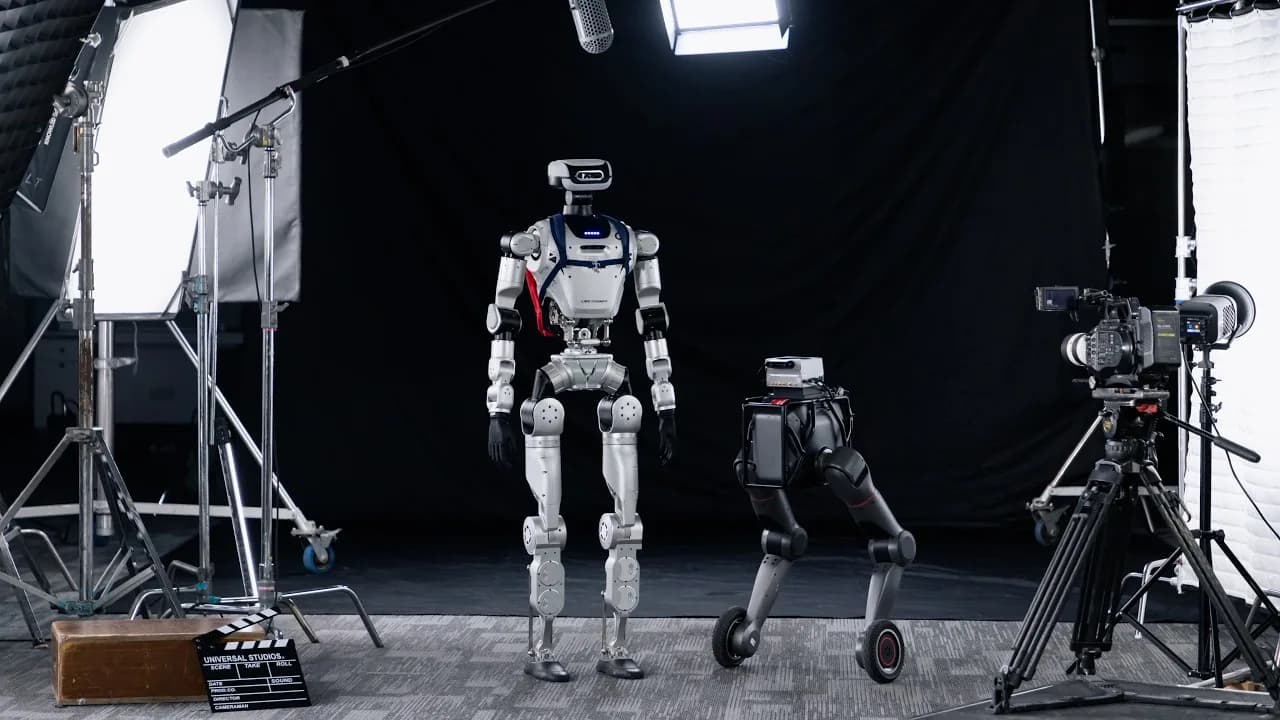
The setting is a film set. The opening card states the problem: the director cannot find the stagehand in the green shirt. Oli's instruction is readable at the bottom of the frame: "Walk forward, find then follow the man in the green T-shirt". The model's interface is overlaid on the robot's own camera view: the instruction text, a step counter, the inference rate, a three-axis velocity command (forward, lateral, yaw) and a blue target region projected onto the floor. Interstitial cards name the model's phases: understanding the natural-language instruction, completing spatial reasoning, locating the person in the green T-shirt and navigating to the target point.
In the second scene the instruction passes to TRON 2: "Find the yellow box and stop in front of it". The robot threads between light stands and crates and halts in front of the box; the card reads "Found it!". In the closing scene a person walks with an equipment cart while TRON 2, in wheeled form, follows behind, and Oli walks on the same set. The end card names the collaboration: LimX Dynamics × Light Origins, LightNav-0 × Oli | TRON 2. There is no narration; the video runs on music and on-screen text.
The values readable in the interface come from the video frames themselves: the inference rate shows around 5 Hz in the Oli scene and around 5.6 Hz in the TRON 2 scene, and the forward velocity command sits around 1.5 m/s on both robots. These are momentary readings from a demonstration, not a published specification.
What Is LightNav-0?
LightNav-0 is a general-purpose navigation model released on 1 September 2026 by the Light Origins team, based in Beijing, Shenzhen and Singapore; the technical report went to arXiv (2608.30935) on 31 August 2026, the weights are on Hugging Face and the code is on GitHub under the Apache 2.0 licence. The model aligns the spatial intelligence of a pretrained vision-language model (Qwen3-VL-4B-Instruct, 4 billion parameters) with navigation. The team's emphasis is architectural restraint: no navigation-specific module is added, no waypoint predictor, no task-specific action head, no per-embodiment expert. Only the vocabulary is extended.
At each decision step the model reads a timestamped egocentric RGB history and the natural-language instruction in a single sequence and emits two things. The first is dual-channel pointing: an affordance point marking a feasible local direction or a free-space waypoint, and an object point marking the task goal; each is one image-grid token, and together they ground the plan in pixels before any action is generated. The second is three RVQ action tokens, which decode into a 10-step SE(2) trajectory (planar position and heading). The coarse codebook resolves roughly 0.9 m, the two residual codebooks 7 cm and 4 cm; even the first token alone decodes into an executable coarse trajectory.
Task semantics come entirely from the instruction; there is no task-identification token. That is why instruction following, open-vocabulary object navigation and visual tracking live in one model and transfer to different robot bodies without further training. Past frames are compressed on a forgetting-curve schedule: older frames are sampled more sparsely and pooled more coarsely while the current frame keeps the finest detail. The training corpus is more than 4,000 hours of vision-language-action experience derived from more than 2,000 real-world scenes, trained in three stages: embodied-reasoning mid-training, supervised fine-tuning and online reinforcement learning.
Published Benchmark Results
The team reports every result from one shared checkpoint and a single forward RGB stream, with no depth, odometry or panoramic rig. The values below are taken from the tables in the GitHub repository.
| Task | Metric | LightNav-0 |
|---|---|---|
| Instruction following (VLN-CE, R2R val-unseen) | Success / SPL | 68.5% / 62.8% |
| Instruction following (RxR, long horizon) | Success / SPL | 73.6% / 64.5% |
| Object-goal navigation (HM3D v2) | Success | 79.5% |
| Open-vocabulary navigation (OVON, unseen classes) | Success | 47.0% |
| Visual tracking (EVT-Bench, single target) | Success | 91.7% |
| Visual tracking (EVT-Bench, with look-alike distractors) | Success | 82.6% |
| INSIGHT-Bench (1,097 episodes, 210 indoor and outdoor scenes) | Success / SPL | 43.7% / 41.5% |
The scaling analysis is instructive for corporate planning. Model size saturates at 4 billion parameters; the 8-billion variant is mixed and mostly slightly worse. Data volume keeps helping with diminishing returns. The one axis that keeps paying is environment diversity: going from one eighth of the training environments to all of them lifts R2R success by 16.7 points and RxR by 21.1. The team's conclusion is explicit: the reliable lever is scene diversity, not parameters or hours.
How Does the Model Reach the Robot?
The deployment architecture is deliberately split. The model runs on a GPU host behind lightnav-serve; the robot carries only a thin WebSocket client. The client streams JPEG frames and the instruction to the server and executes the first waypoint of the returned trajectory in each control period. Several robots can share one server, with sessions micro-batched. The robot's own low-level controller (gait, wheels, balance) stays outside the model; this interface is precisely what keeps the model embodiment-agnostic: SE(2) waypoints are handed to each body's own controller.
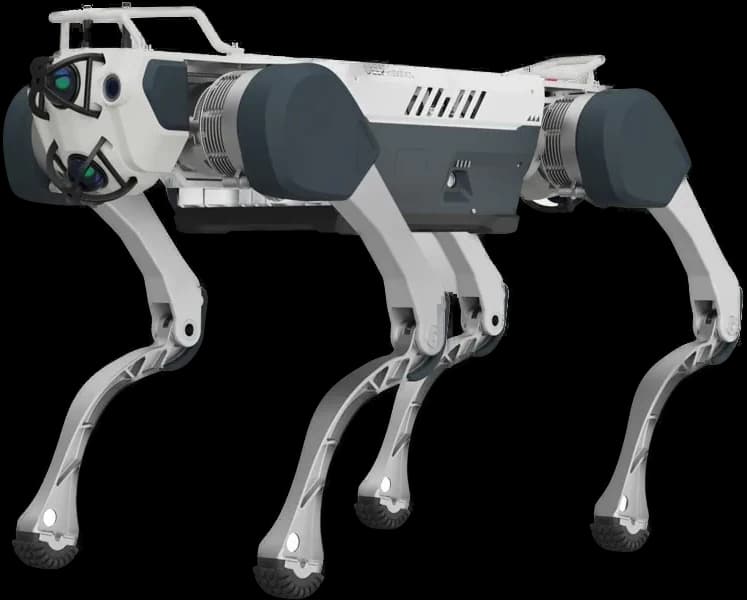
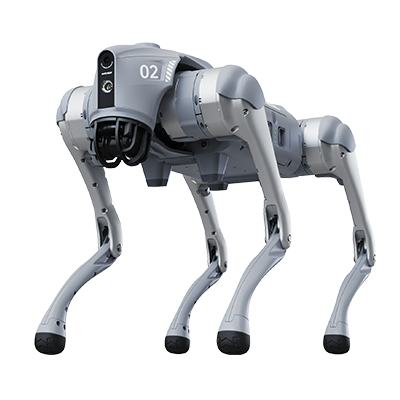
The repository also ships a complete ROS 2 on-robot stack: camera driver, WebSocket client, a model-predictive-control waypoint tracker and a web control panel. The published adapters are for the Unitree Go2 and the LimX TRON 1, with a bring-your-own-robot adapter interface for teams connecting their own platform. The Oli and TRON 2 integration in the video was done by LimX, and that deployment layer is not public.
The instruction grammar is documented too. A good instruction is one action verb, an optional direction, an unambiguous object phrase and an optional stop clause: "Turn left and walk to the red lamppost", "Go to the desk on your right and stop". Directions are relative to the robot, not the room. Both instructions in the video fit this template exactly.
Oli and TRON 2: Two Bodies, One Model
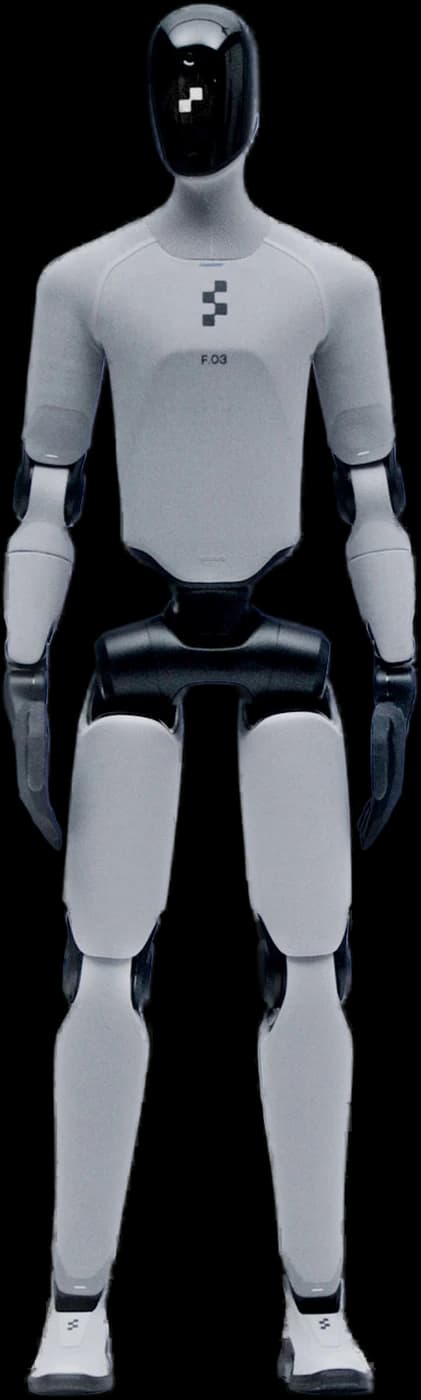
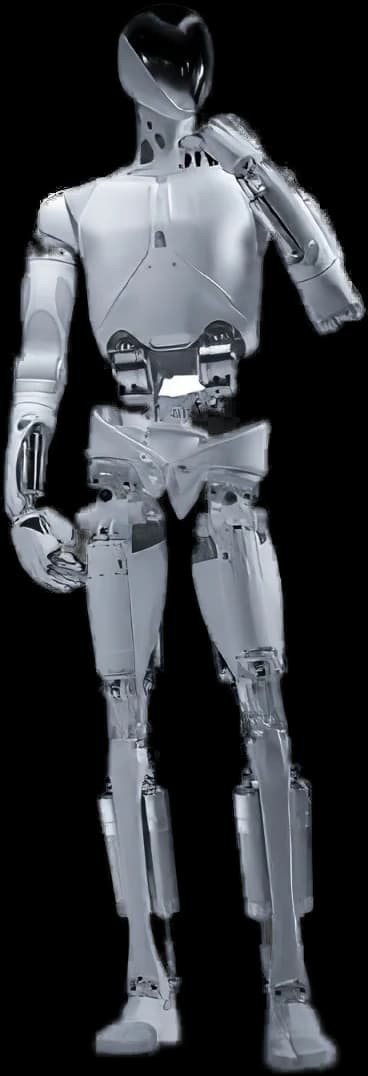
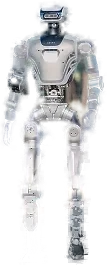
LimX Oli is a full-size general-purpose humanoid offered in three editions: Lite and EDU stand 165 cm, Super 175 cm; active degrees of freedom are 31, 33 and 43 by edition (6 per leg, 7 per arm, 3 in the waist, 2 in the neck). Weight stays under 55 kg (Lite, EDU) or under 60 kg (Super) including the battery; battery and modules are quick-swappable. In the video Oli follows the person walking on two legs.
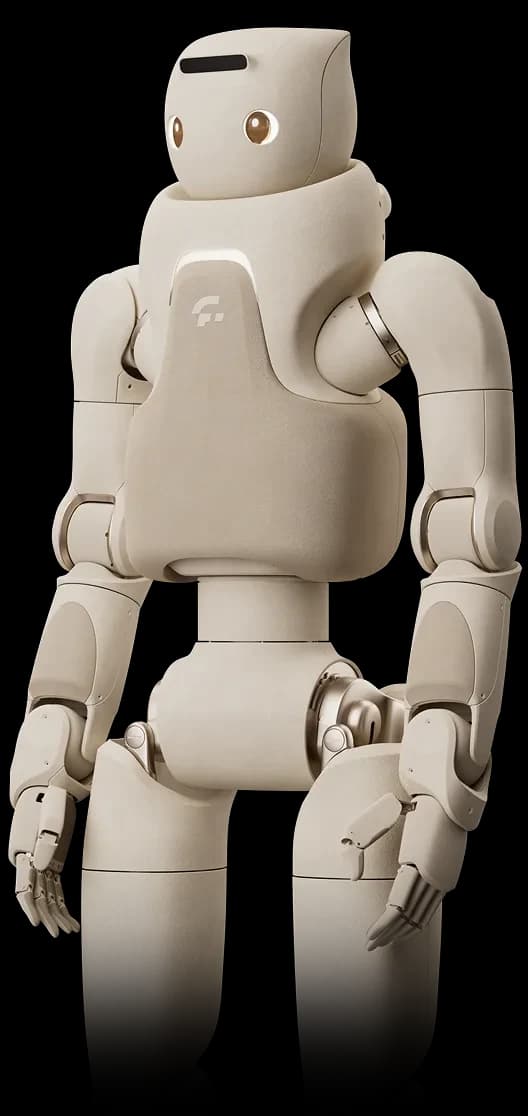
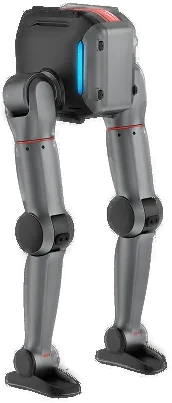
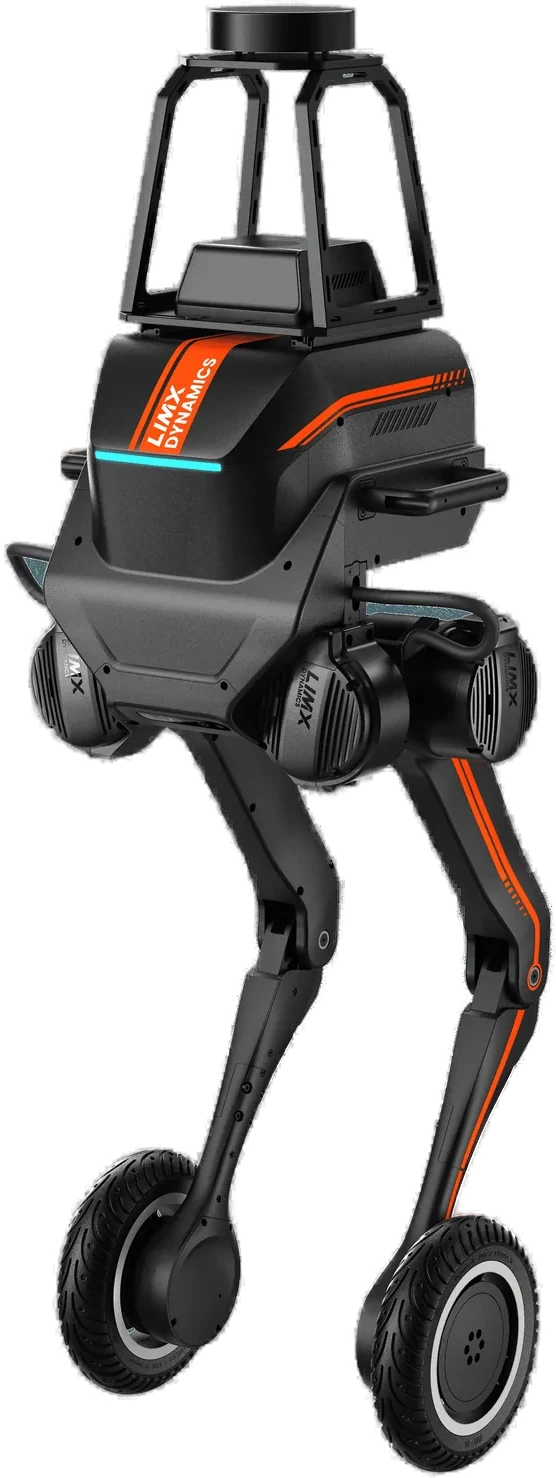
LimX TRON 2 is a mobile manipulation platform with three forms: dual arm, wheeled leg and base. It carries 7 degrees of freedom per arm, 5 per leg and a 2-axis active vision head, and lifts up to 5 kg per arm (3 kg extended). Omnidirectional movement, crouching in place, body-height adjustment and getting up after a fall are in the manufacturer's table. In the video TRON 2 is in wheeled-leg form; it rolls across the flat studio floor and stops in front of the yellow box.
The real claim of the demonstration lies in the difference between these two bodies. One is bipedal, the other wheeled-legged; their camera heights, speeds and controllers differ. The same model weights command both through the same token interface; the only body-specific element is the low-level layer that turns waypoints into motion commands.
What It Means for a Corporate Buyer
First consequence: navigation is becoming a software layer decoupled from hardware. Until now navigation capability came with the vendor's closed software; an open-weight model under Apache 2.0 lets an R&D team operate this layer on its own GPU host, with its own data and its own robot fleet. One server serving several robots matters further for fleet architecture.
Second consequence: the sensor list gets shorter. The model runs on a single forward RGB camera; it needs no depth camera, LiDAR or panoramic rig. This lowers cost and integration effort, especially on research platforms. In safety-critical applications, however, an independent safety layer for obstacle detection and emergency stop remains necessary; the model is a navigation policy, not a certified safety system.
Third consequence concerns scale. The demonstration was staged in a controlled studio with two instructions. The published INSIGHT-Bench result (43.7% success) shows plainly that the model does not complete every instruction across a real-world distribution. The right starting point for a corporate pilot is the two tasks in the video themselves: following a person (site guidance, escorting material transport) and going to a described object and stopping (the first step of fetch tasks). Both can be defined with measurable acceptance criteria, and the model's success on your site is counted in your own environment rather than on a benchmark.
In Turkey we deliver LimX hardware to corporate projects through enterprise supply, commissioning and engineering support; the Unitree Go2, which has a published adapter, is supplied from stock with warranty, central service and a remote/on-site technical support protocol (SLA). For teams planning a LightNav-0 pilot we work out robot selection, GPU host sizing and acceptance criteria together; sending us your technical specification is enough to start.