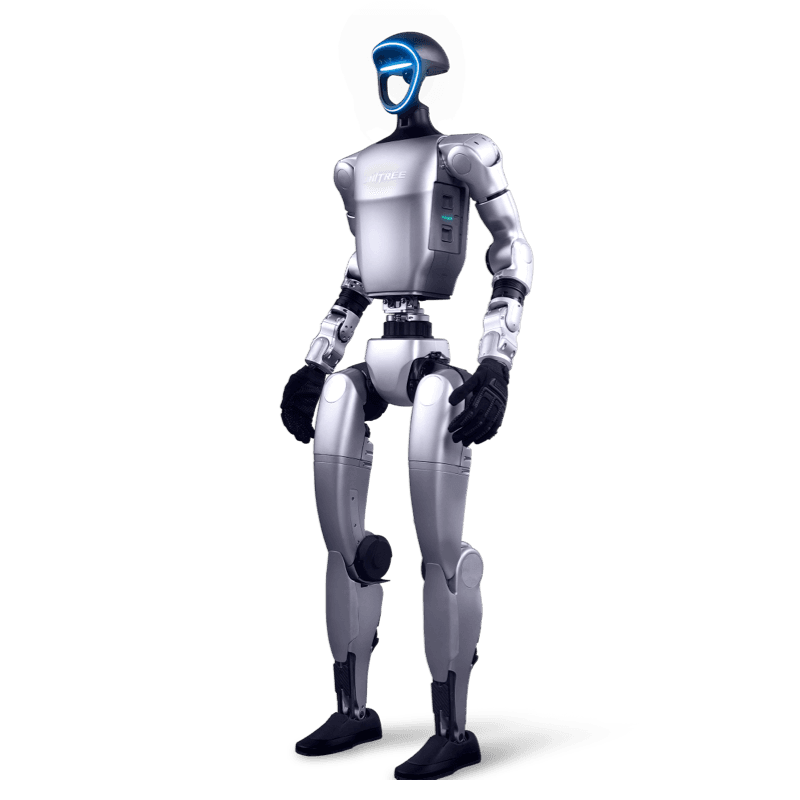
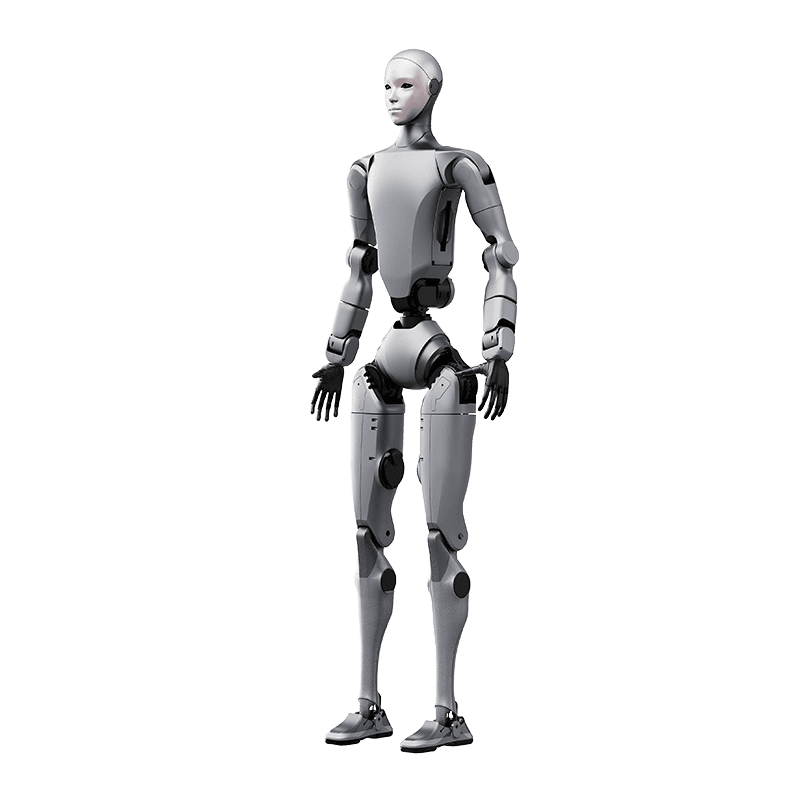
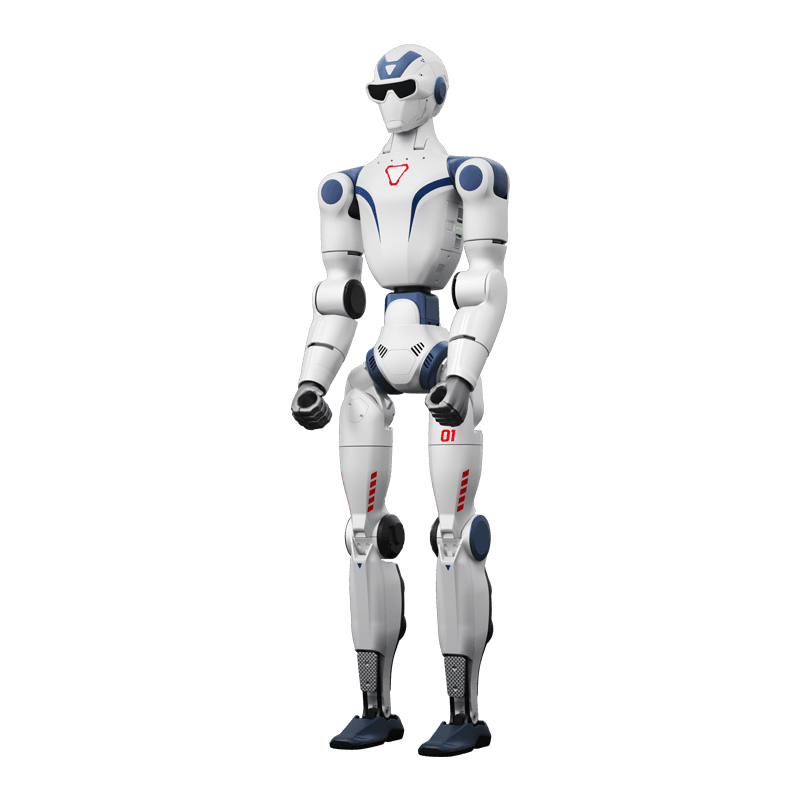
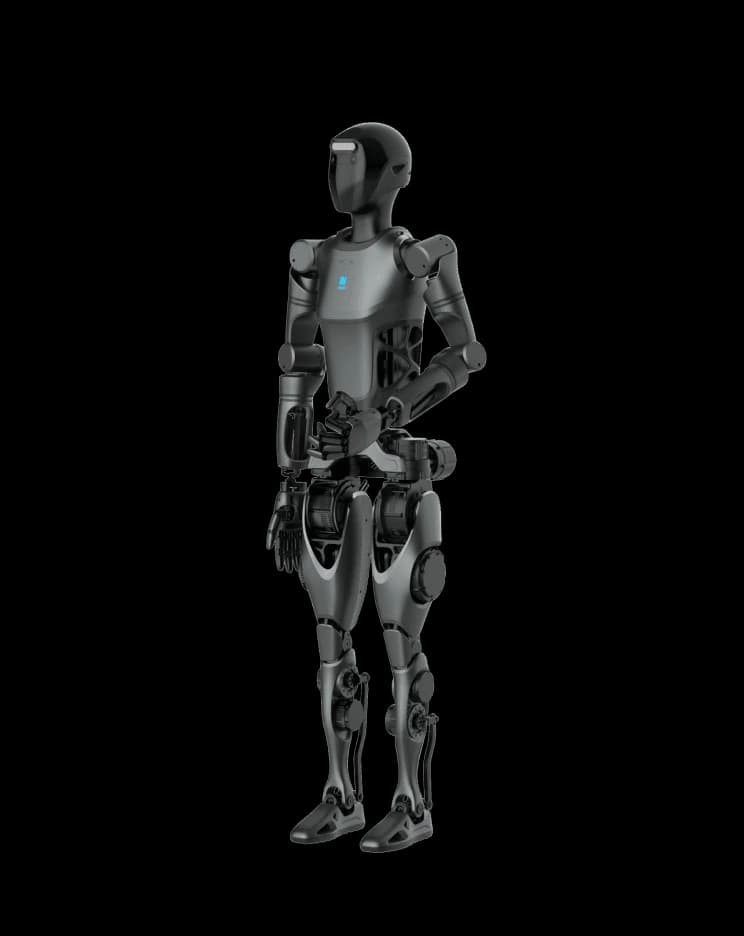
Asimov 1 (Menlo Research): open-source humanoid robot research report
Asimov 1 is Menlo Research's open-source bipedal humanoid; it has nothing to do with Isaac Asimov's laws of robotics, the name is just the product name. We opened the files in the repository, ran the simulation model, counted the numbers and wrote down what we could not verify.
8 November 2026 · Repository reading and simulation check · Robotlar.org
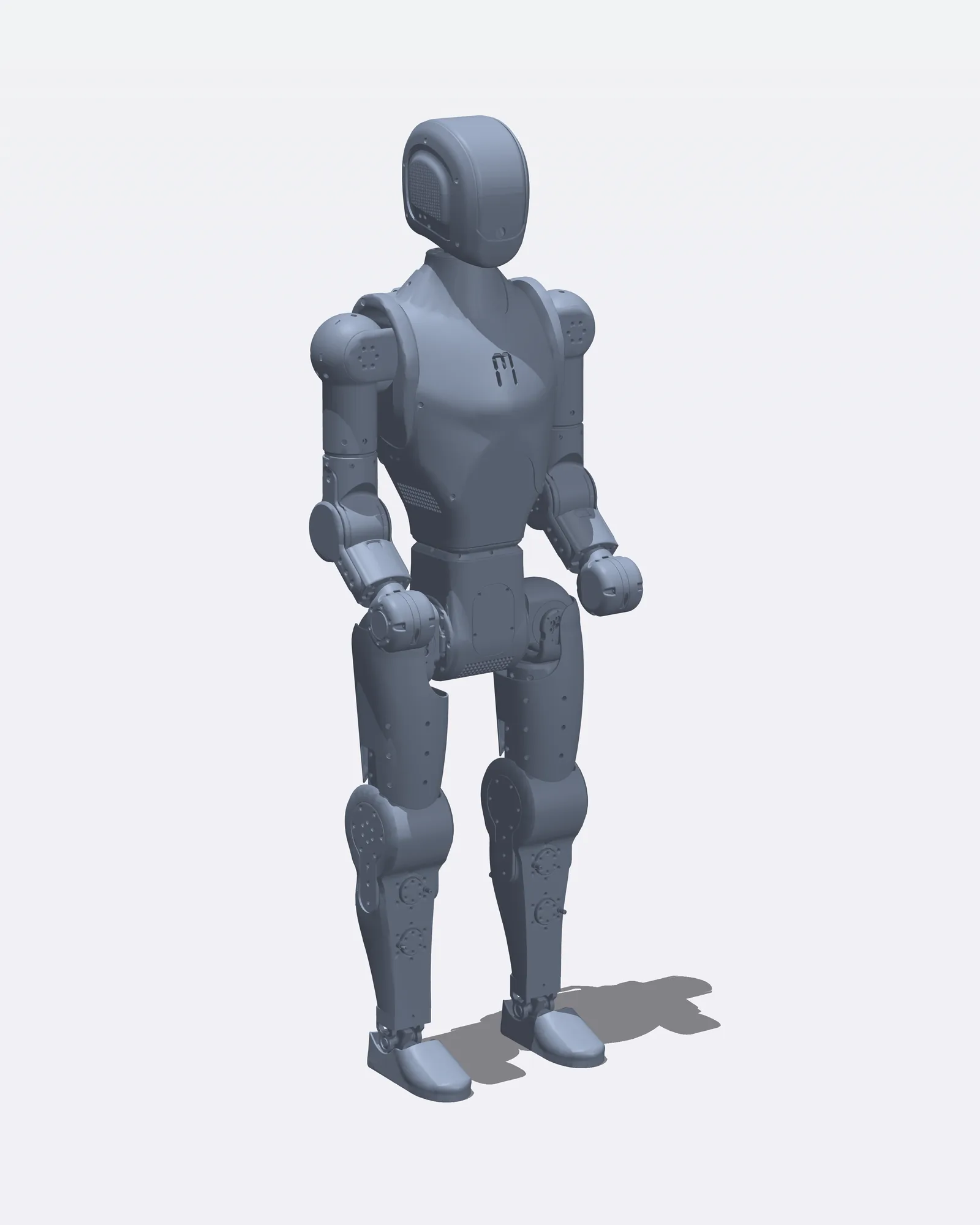
In brief
- 01Height and mass: about 1.2 m and about 35 kg (maker's claim); 35.55 kg in the simulation model.
- 02Joints: 25 actuated degrees of freedom (legs 6x2, arms 5x2, waist 1, neck 2).
- 03License: hardware CERN-OHL-S-2.0, software GPL-2.0.
- 04Status: the maker offers a DIY kit; check the maker's pages for price, delivery and shipping. A walking policy is not in the repository.
- 05Independence: Robotlar.org is not affiliated with the maker and has not built or tested the robot.
What is Asimov 1?
Asimov 1 is an open-source bipedal humanoid robot design that Menlo Research publishes on GitHub at menloresearch/asimov-1. The repository bundles mechanical CAD in seven subassemblies, electrical schematics and PCB files, wiring lists, MuJoCo and URDF models and a fabrication manifest. At the time of writing (8 November 2026, gh api) it has 1444 stars, 241 forks and 10 contributors; there is no release tag.
Sources give two names for the maker: the README mentions both asimov.inc and Menlo, and the repository sits under the menloresearch account. According to Menlo Research's own handbook the team works across Singapore, Vietnam and the US, and Asimov was officially announced in April 2026. The earlier model, Asimov 0, was a legs-only platform.
The repository is more a hardware and asset repository than a software one: by GitHub's language breakdown it holds only 4800 bytes of Python and 69 bytes of shell script. The README says 'onboard software', but no software that runs on the robot is in the repository.
The maker offers a DIY kit. According to the order page (menlo.ai/order, 8 November 2026) the kit shows as 'Batch 5, Forming', orders are taken with a deposit, the estimated build time is 20 hours, and for an assembled option you are asked to talk to sales. The product page (menlo.ai/asimov) states worldwide shipping, duties and tariffs covered in most countries, and assembly and servicing partners in the USA and Singapore; the order page says the final price may vary by destination country, tariffs and shipping. The build time is the maker's estimate; we have not verified it. We found no separate written confirmation for shipping to Turkey. For current price and delivery, check the maker's pages.
The official page lists the kit contents as: parts for all seven modules and every bolt, 25 actuators across five types, a battery and charger, a Raspberry Pi 5, a Radxa CM5, a 2 MP camera, control boards, ready-made actuator cables and a metric Allen key set; workshop tools such as a soldering iron and a multimeter are expected from the user. The repository also makes self-sourcing possible: CAD and manifest are open, while the identity of off-the-shelf parts sits in an external bill of materials (manual.asimov.inc/v1/bom).
Technical specifications
The left column is what the README and the maker state; the right column is what we read from repository files or from our own simulation run. They do not say the same thing on every row; differences are explained in the text.
Asimov 1 specifications: claims and checks side by side
| Item | Claim (README, maker) | What we read from files and simulation |
|---|---|---|
| Height | 1.2 m | Mesh bounding box 1.254 m (zero pose, sim model) |
| Mass | 35 kg | 25 DOF model 35.552 kg; 27 DOF model 36.758 kg |
| Degrees of freedom | 25 actuated: legs 6x2, arms 5x2, waist 1, neck 2 | 25 joints in the URDF, 25 unique joints in the wiring CSV |
| Compute | Radxa CM5 (motion control), Raspberry Pi 5 (media and network) | MCB board is a CM5 carrier; Pi 5 sits in the head, linked by Ethernet (cable list) |
| Communication | CAN: 5 channels at 1 Mbps, 1 channel at 500 kbps | 6 MCP2518FD channels; which one runs at 500 kbps is not in the repository |
| Material | 7075 aluminum, MJF PA12 | The manifest also lists 316L stainless steel (SLM) parts |
| Joint torque limit | Maker pages state 120 N·m peak torque | URDF effort: between 12 and 45 N·m; the gap is not explained |
| Ankle roll range | Not stated | +/-0.1 rad (about 5.7 degrees); the reason is not written in the repository |
| Hand | DIY kit table says 'hands not included' | No hand CAD (subassemblies 350 and 450) in the repository |
| License | Hardware CERN-OHL-S-2.0, software GPL-2.0 | GitHub shows only the CERN-OHL-S-2.0 label |
Sources: README (Specifications), electrical/README.md, sim-model URDF and MJCF, electrical/wiring/*.csv, our own MuJoCo 3.3.7 run. The mesh height may include the head and protrusions; 1.2 m is a reasonable rounding, not an exact match.
README payload table (maker's claim, unverified)
| Motion | Rated load | Peak load |
|---|---|---|
| Squat | 5 kg | Not stated |
| Biceps curl | 5 kg | 15 kg |
| Front raise | 5 kg | 15 kg |
| Lateral raise | 6 kg | 18 kg |
For the raise motions the values are per arm. Not an independent measurement; our rough calculation is in the 'What we could not verify' section.
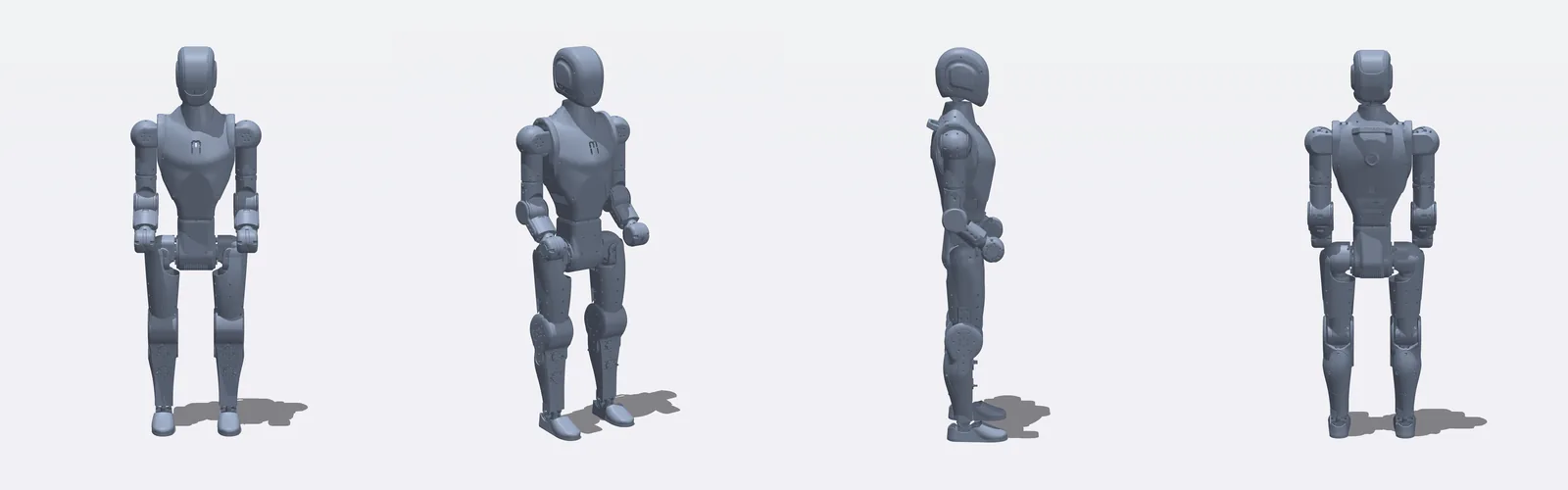
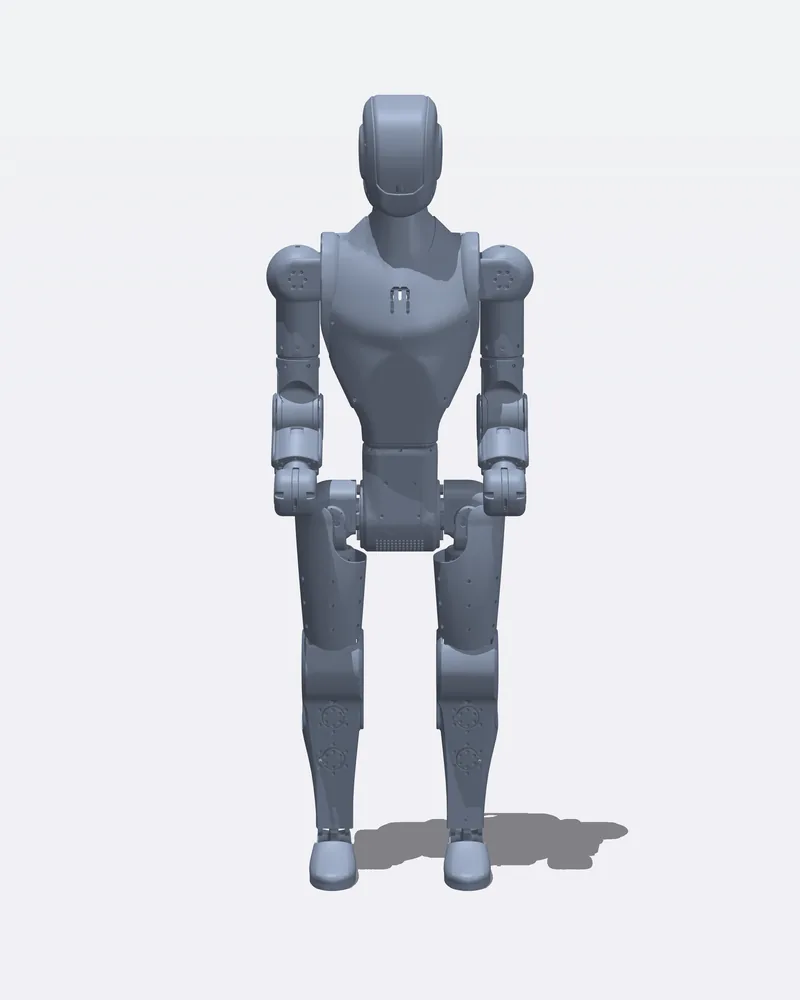
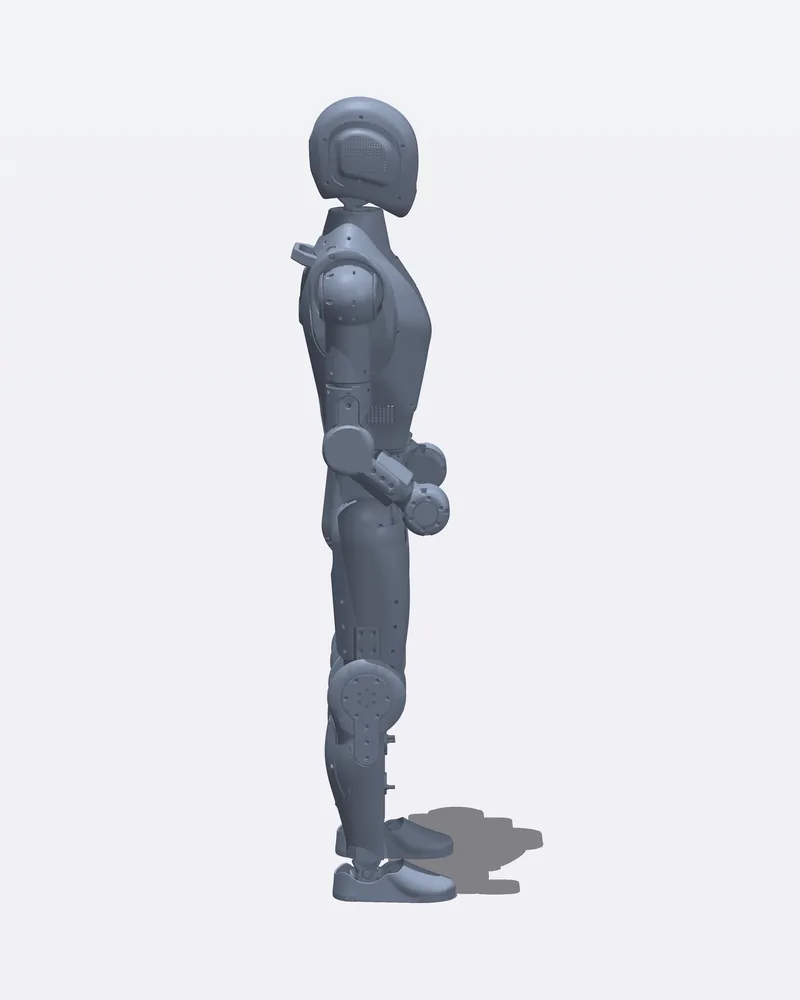
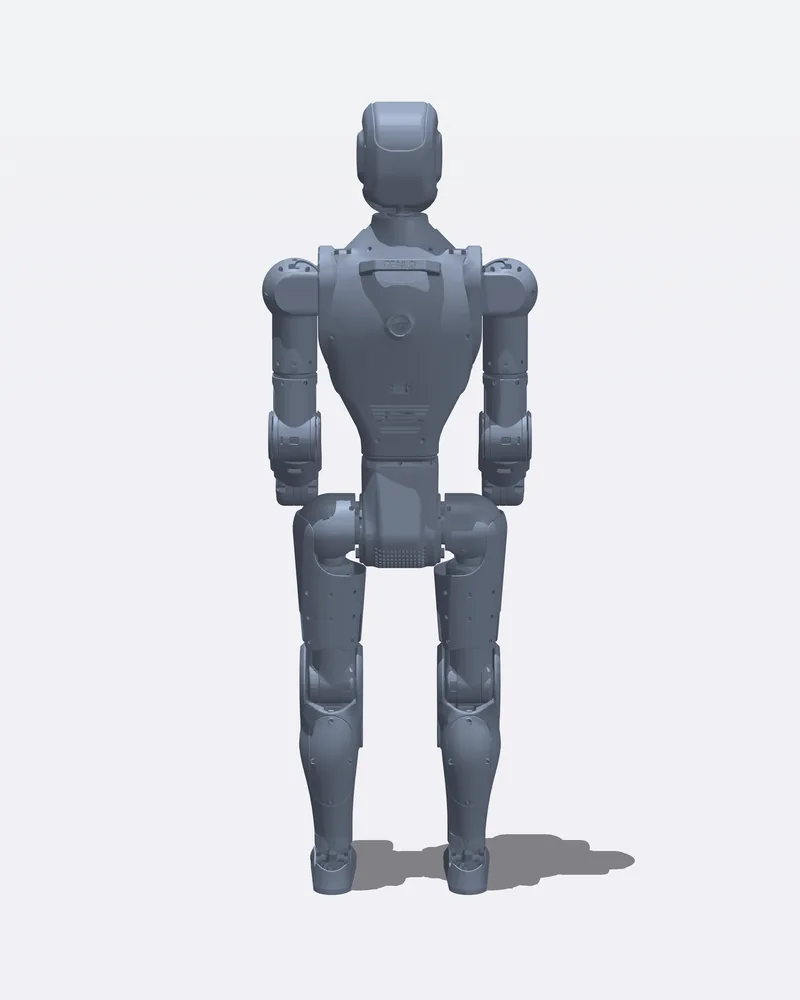
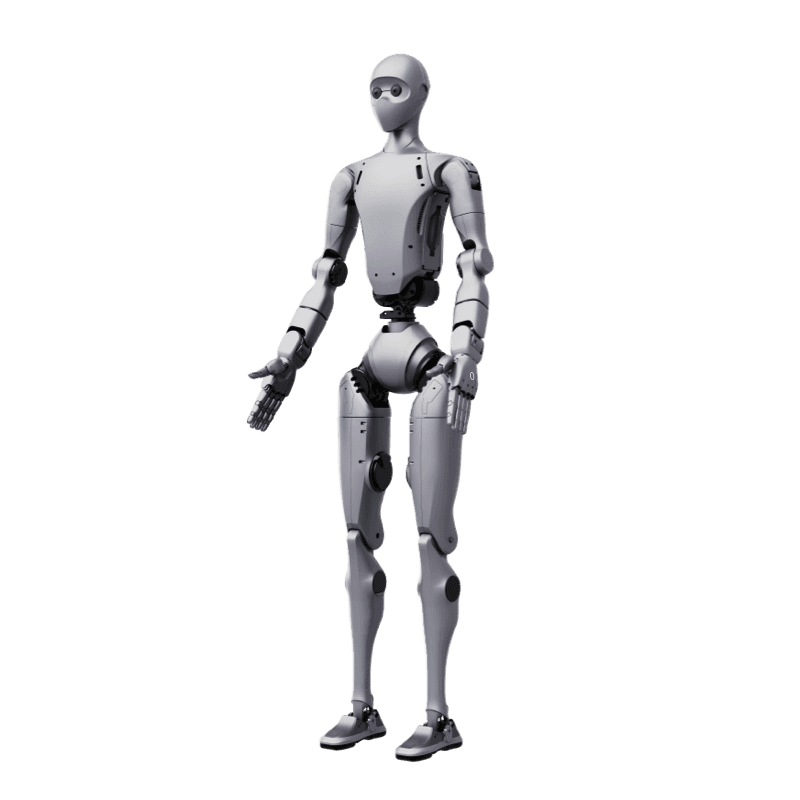
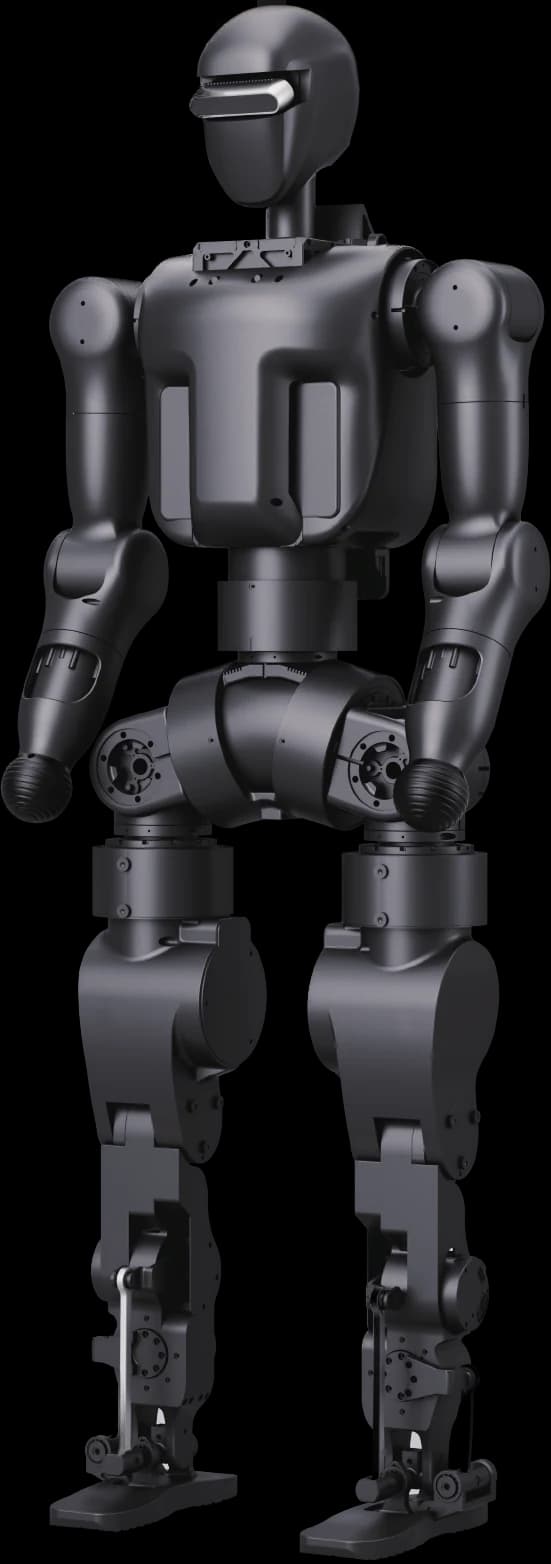
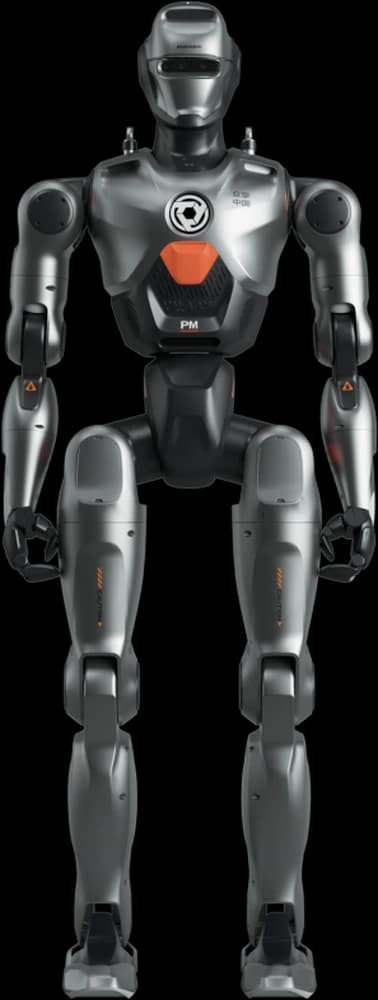
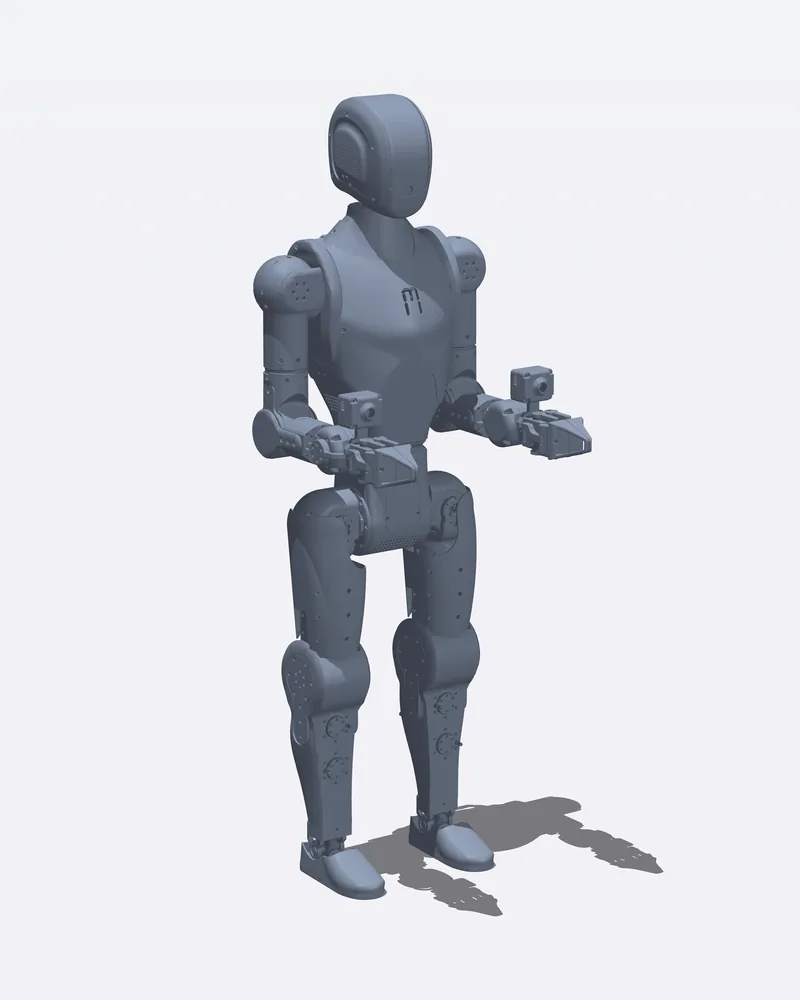
The images were produced from the simplified simulation mesh in the repository: electronics, cables and fasteners are absent, and the gap between head and neck comes from the mesh structure.
Mechanical: 167 fabrication files, four methods
The mechanical folder splits the robot into seven subassemblies: 100 torso, 200 waist, 300 right arm, 400 left arm, 500 right leg, 600 left leg, 700 head. The CAD for codes 350 and 450, reserved for hands, is not in the repository. A part name such as ASV1_500_02A reads as project, subassembly, part number and a final letter for the method (A: 7075 aluminum CNC, B: 316L SLM metal print, C: MJF PA12 nylon print, X: off-the-shelf part).
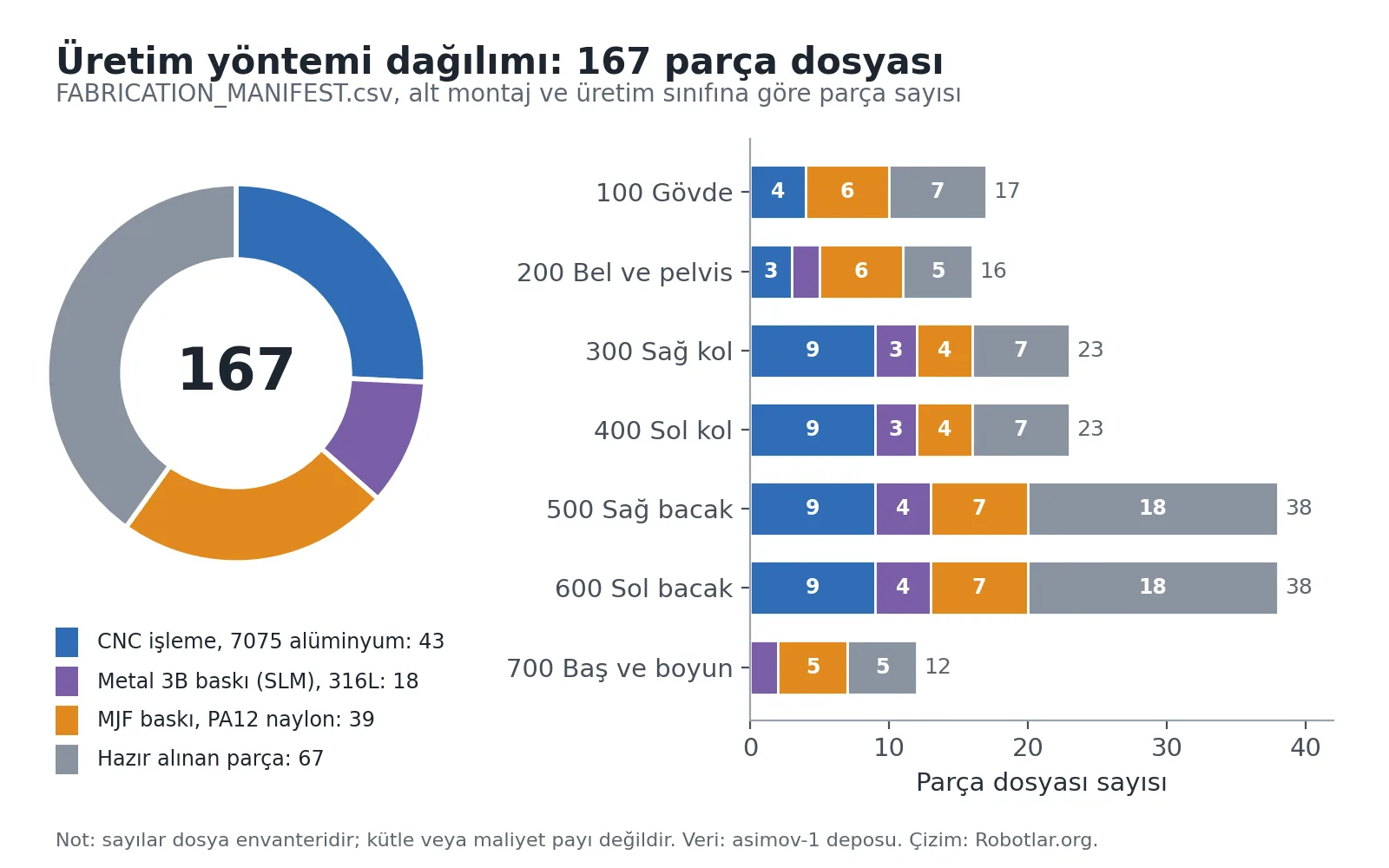
FABRICATION_MANIFEST (CSV and JSON, consistent with each other) lists 167 entries: 67 off-the-shelf parts, 43 CNC 7075 aluminum, 39 MJF PA12, 18 SLM 316L. This is a file inventory with no quantities: 167 is the number of design files, not of physical parts in the robot. Comparing the content of the 163 readable files gave only 129 distinct contents: the same off-the-shelf part is repeated under several numbers across the right and left legs. Whether an off-the-shelf part is an actuator, bearing or bolt cannot be told from the STEP files; they carry only a part number.
File count by subassembly and method (FABRICATION_MANIFEST.csv)
| Subassembly | 7075 Al CNC | 316L SLM | MJF PA12 | Off-the-shelf | Total |
|---|---|---|---|---|---|
| 100 Torso | 4 | 0 | 6 | 7 | 17 |
| 200 Waist | 3 | 2 | 6 | 5 | 16 |
| 300 Right arm | 9 | 3 | 4 | 7 | 23 |
| 400 Left arm | 9 | 3 | 4 | 7 | 23 |
| 500 Right leg | 9 | 4 | 7 | 18 | 38 |
| 600 Left leg | 9 | 4 | 7 | 18 | 38 |
| 700 Head | 0 | 2 | 5 | 5 | 12 |
| Total | 43 | 18 | 39 | 67 | 167 |
The counts are a file inventory, not a share of mass, cost or quantity.
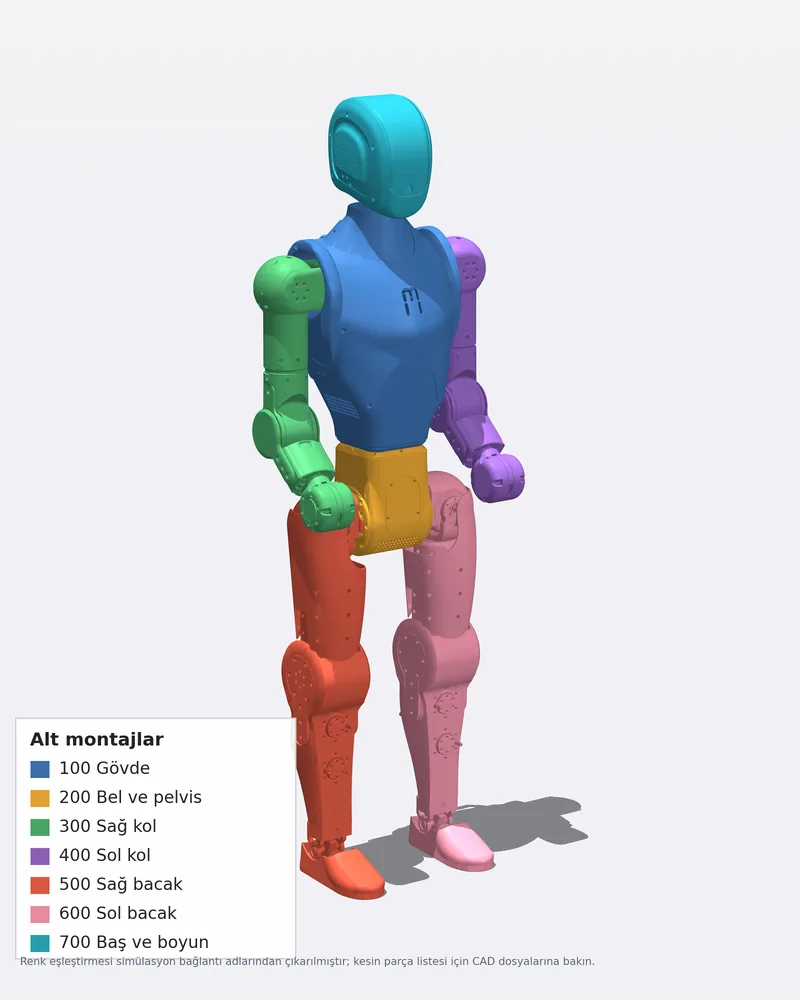
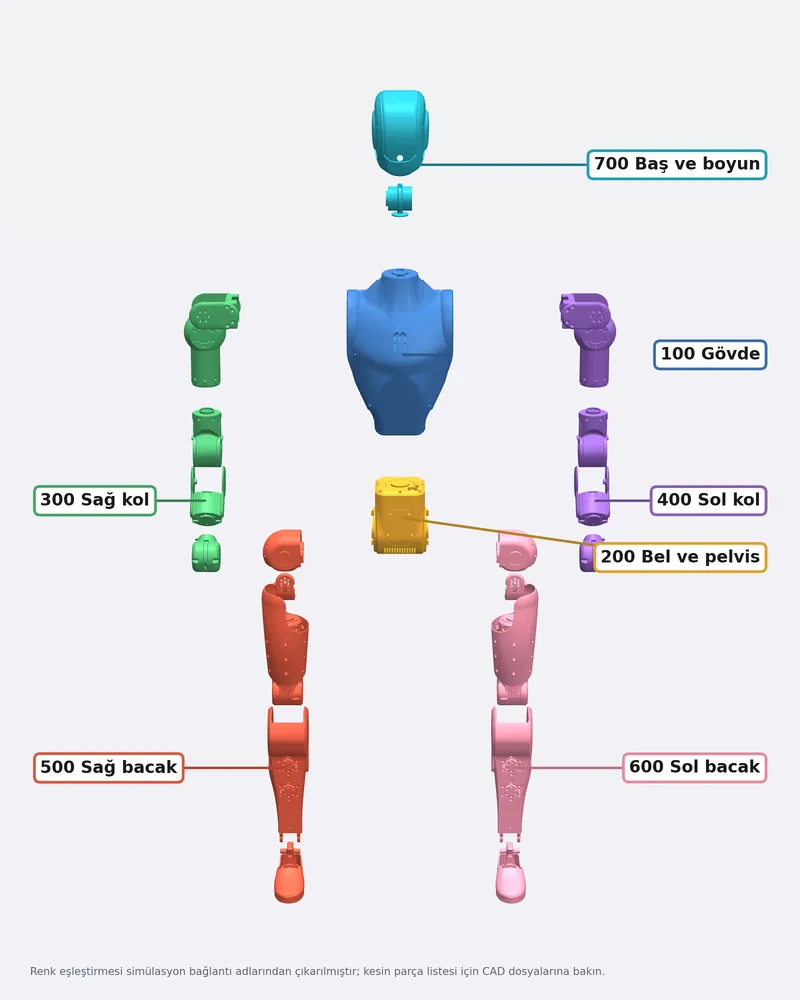
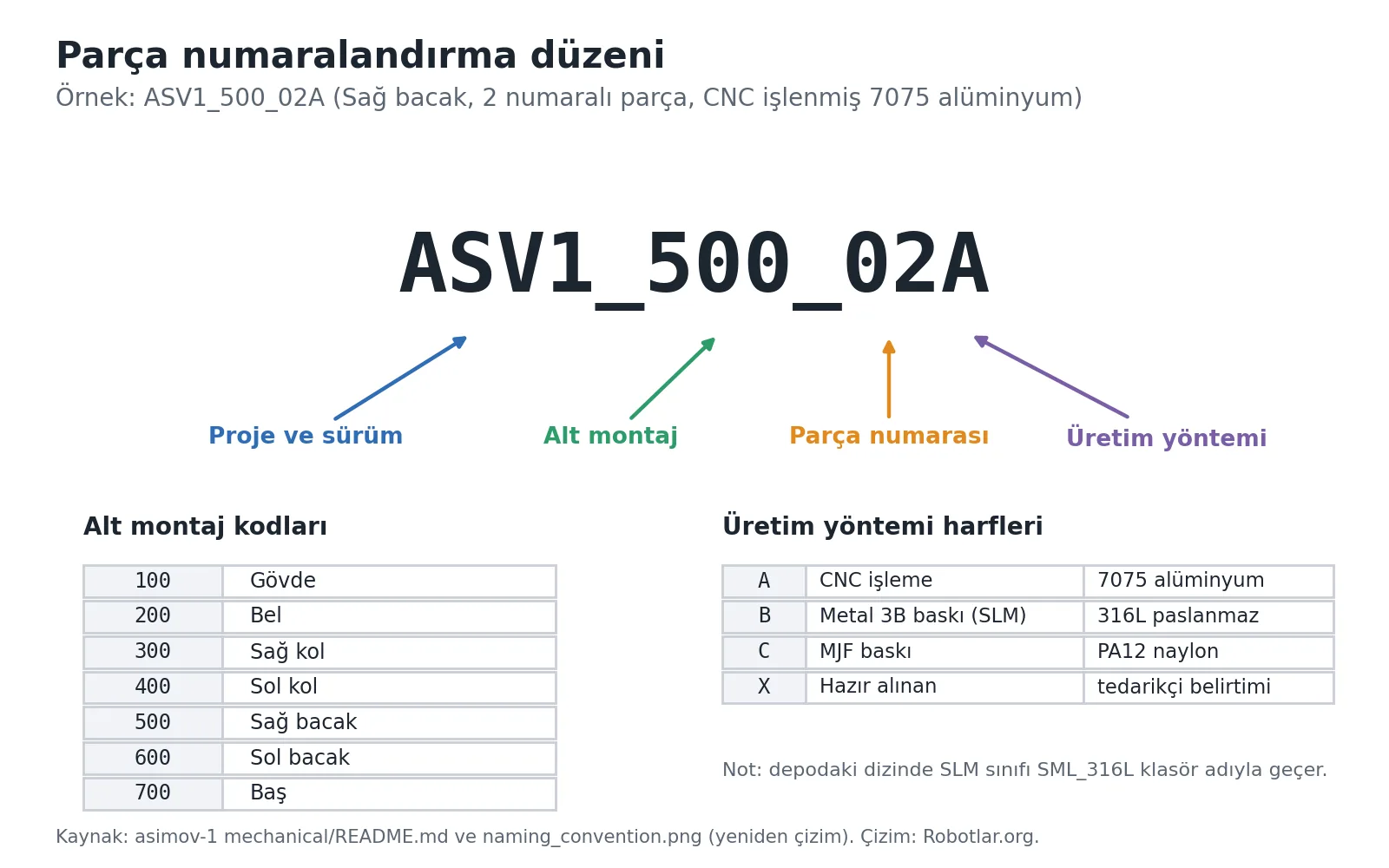
Accessories (a TPU 95A FDM shoe sole, PLA dummy hands as a Bambu Studio project, and a stool) are provided separately. The mapping in the colored subassembly image (which mesh link belongs to which subassembly code) is derived from simulation link names; because the real CAD files arrived as Git LFS pointers, we could not verify it against CAD.
Electrical: six CAN channels and a two-board RPU
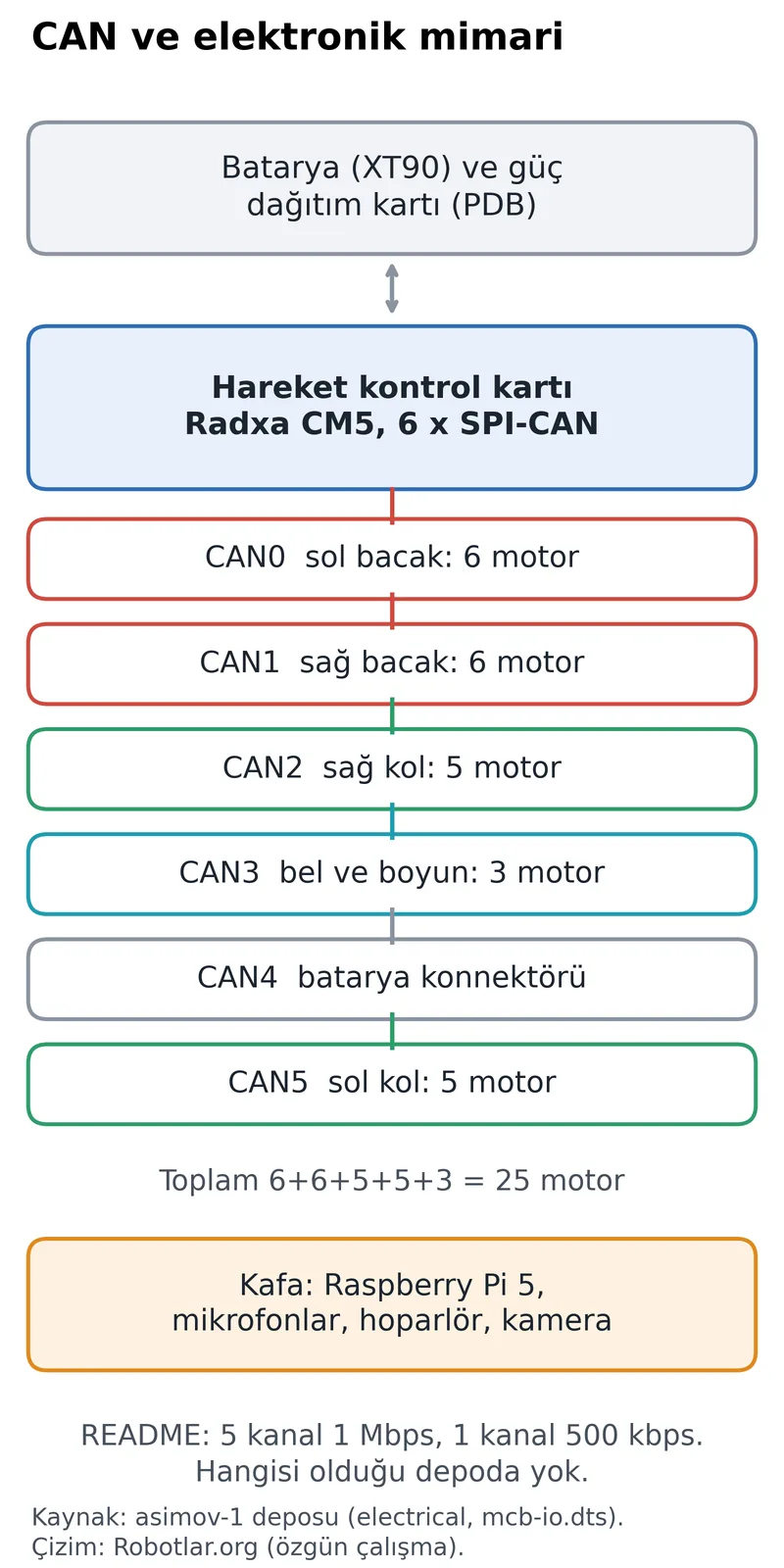
The center is a two-board stack called the RPU (Robot Processing Unit). The lower Motion Control Board (MCB) is a carrier for the Radxa CM5 and holds the IMU (LSM6DSV) and the motor communication lines. The upper Power Distribution Board (PDB) takes the battery through an XT90(2+2) connector, distributes it to the motor lines and makes the auxiliary supply with a single 30 W, 5 V converter (HI-LINK URB4805LD-30WR3). The head also holds a Raspberry Pi 5, a head board and a Pi 5 hat. Battery voltage, capacity and chemistry are not written in the repository.
Motors speak CAN. The MCB has six independent channels, each made of one MCP2518FD SPI-CAN controller, one SN65HVD230 transceiver, one 40 MHz crystal and one 120 ohm termination resistor (mcb-io.dts: three SPI ports with two chip selects each, 20 MHz SPI clock). The CM5 side runs 1.8 V and the CAN controllers 3.3 V, so four TXB0104PW level shifters sit in between. We derived the channel mapping from a pad-net analysis of the PDB board. Each joint is daisy-chained from the previous one; the cable uses XT30(2+2) (two power pins, two CAN pins).
Wiring is listed in two CSVs: 32 motor cables (6.9 m) and 7 miscellaneous cables (2.67 m), so 39 ready-made cables, 9.57 m in all. Wire gauge, color and fuse information are not in the CSVs. Boards are in KiCad 10 format with LCSC part codes: the MCB has 4 layers and 76 footprints, the PDB 4 layers and 25 footprints. The head board is in EasyEDA Pro (.epro) format, not KiCad, and has no Gerber files.
CAN channel, connected region and joint count (PDB pad-net analysis)
| Channel | PDB connector | Region | Joints |
|---|---|---|---|
| CAN0 | J104 LEFT_LEG | Left leg | 6 |
| CAN1 | J105 RIGHT_LEG | Right leg | 6 |
| CAN2 | J109 RIGHT_ARM | Right arm | 5 |
| CAN3 | J106, J112, J115 | Neck pitch, neck yaw, waist yaw | 3 |
| CAN4 | J113 BATT_IN | Routed to the battery connector | 0 |
| CAN5 | J107 LEFT_ARM | Left arm | 5 |
The purpose of routing CAN4 to the battery connector, and which channel runs at 500 kbps, are not written in the repository.
Simulation: the MuJoCo model and the 25/27 DOF difference
The sim-model folder holds two models. asimov_1_25dof represents the production configuration: a floating base, IMU sensors, rotor inertia per joint and an MJCF without actuators (per the README, actuators are configured by the training code). asimov_1_27dof adds a sixth joint to each arm and a six-joint parallel gripper; its base is fixed and it has only two gripper motors. The 27 DOF model differs from the production configuration and should be read as a 'simulation model'.
Our own check: we loaded both models in Python with mujoco 3.3.7 and both loaded without errors. The README gives 3.4.0 as the validation version; no wheel existed for our Python 3.9 environment. The 25 DOF model has 25 hinge joints and a free base, total mass 35.552 kg; the README's '25 actuated' and '35 kg' matched (mass differs by about 1.6 percent). Dropping the actuator-free model for 1.5 seconds stayed numerically stable and the pelvis collapsed from 0.63 m to 0.445 m, as expected for a model without drives.
An important warning (our inference): the joint zero convention is not identical across the two models. In the 27 DOF model the elbow range is shifted by about 35 degrees (25 DOF right [-2.0944, 0]; 27 DOF right [-1.4836, 0.6108]) and the wrist yaw axis has the opposite sign. The README only says 'joint zero angles keep the 25-DOF convention'. Moving a policy between models requires remapping joint order, signs and offsets. The simulation mass also changed over time: 32.37 kg in the 17 April version, 32.23 kg in the 13 August version, 35.55 kg today; most of the increase comes from fastener mass added in the October 2026 update (PR #29).
25 DOF and 27 DOF simulation models (result of loading with MuJoCo 3.3.7)
| Item | 25 DOF | 27 DOF |
|---|---|---|
| Joint count (njnt) | 26 (1 free base + 25 hinges) | 39 hinges (27 body, 2 gripper drives, 10 linked gripper joints) |
| Base | Free, pelvis z = 0.63 m | Fixed |
| Arm | 5 DOF per arm | 6 DOF per arm and a six-joint parallel gripper |
| Actuators and sensors | No actuators; 5 sensors | 2 gripper motors; no sensors |
| Time step | 0.005 s, implicitfast | 0.002 s, default integrator |
| Total mass | 35.552 kg | 36.758 kg |
| Neck torque limit | 12 N·m | 40 N·m |
Source: sim-model MJCF/URDF files and sim-model/README.md. Run: mujoco 3.3.7, numpy 2.0.2, Python 3.9.6.
Experiments and development line
The repository has no 'experiments' or test folder; we inferred development from the commit and pull request history.
Selected events, 2026
| Date | Event | Source |
|---|---|---|
| 8 April | asimov-1 repository created | GitHub API |
| 17 April | First sim model: 23 torque motors, 32.37 kg | Commit a125483 |
| 25 April | Open-source launch PR merged | PR #2 |
| 17 May | Community Isaac Gym RL port; closed without merging | PR #9 |
| 21 August | 'Asimov v1 Upgrades': head, legs, torso, foot, arms (204 files) | PR #17 |
| 28 September | Joint ranges aligned to hardware limits | PR #25 |
| 22 October | 25 and 27 DOF split, gripper, fastener mass | PR #29 |
| 28 October | asimov-1-amp repository created | GitHub API |
| 4 November | Shoe, dummy hands and stool assets; latest commit 43aa368 | PR #31 |
Community RL experiments run outside the repository: in the reply to PR #9 the repository is described as an entry point for assets, not for training code. The findings in that PR body are instructive (we did not repeat them): the right ankle pitch axis mirrors the left, PD gains tuned for another robot cannot lift Asimov's heavy legs, and a sparse foot air-time reward drives the policy into a 'feet stuck together' local optimum. Two more repositories exist under the maker's account: asimov-mjlab (12 DOF legs, mjlab, MuJoCo sim2sim demo) and asimov-1-amp, opened on 28 October (Isaac Lab, velocity tracking with AMP, 23 joints). asimov-1-amp is pinned to an old commit (35ae7b3) and an old URDF path; because the 22 October restructure changed the path, running it with the latest version requires pinning the commit.
Automated checking is plain: the only workflow in the repository (fabrication-manifest.yml) checks that the fabrication manifest is up to date; whether the simulation model loads, URDF and MJCF consistency, linting and unit tests are not checked automatically. On the roadmap 'Locomotion policy' and 'Asimov Edge' are still 'coming soon'; the repository holds no detail on them. The maker's documentation says a full-body locomotion policy is included in the supplied firmware and that direct actuator control is available through Asimov Edge or the Asimov SDK (docs.menlo.ai/asimov/1); we have not seen these, and the firmware download is marked 'coming soon' in the documentation.
License: CERN-OHL-S-2.0 and GPL-2.0
This section is a plain summary of the license texts and is not legal advice. For a commercial use or derivative product decision, consult a lawyer.
Plain comparison of the two licenses (per the texts)
| Topic | Hardware: CERN-OHL-S-2.0 | Software: GPL-2.0 |
|---|---|---|
| Type | Strongly reciprocal open hardware license | Copyleft software license |
| Commercial and academic use | Making, selling and copying are free; no separate academic clause | Running, modifying and distributing are free |
| If you distribute | Give every recipient the complete source or state where the source is | Provide the source code or access through a written offer |
| If you modify | Note the change and its date, use the same license, keep notices | The derivative must be under the GPL as a whole |
| Name and logo | No use of the licensor's name that implies endorsement (Section 8.2) | Copyright and license notices are kept |
| Warranty | None (Section 6) | None |
Uncertainties: we found no copyright holder or SPDX notice in file headers; it is not clear which file counts as hardware and which as software. In particular, which license the sim-model folder and the electronics files fall under is not written. Whether 'GPL-2.0 only' or 'or later' is intended is also unclear. The license of the photograph in the repository (assets/asimov-v1.jpg) was not verified; for that reason we used our own renders on this page, not that photo.
What we could not verify, and what is missing
We state none of the points below as a definitive verdict.
- STEP files missing through Git LFS: the full-body assembly (Asimov_1.STEP, about 520 MB by the size written in the pointer), four MJF leg parts, the dummy hands project and the stool STEP files arrived locally as LFS pointers (10 files). 163 of the 167 fabrication STEP files are readable. This is why we produced the renders from the simulation mesh, not from real CAD.
- No actuator model: maker, model, gear ratio and weight are not written in the repository; simulation actuators are left to the training code and there are no PD gains.
- Payload claims: the README peak loads did not agree with our simple calculation; we write this as a question needing verification, not as an error claim. With the left shoulder roll opened 90 degrees, the horizontal distance between the shoulder axis and the wrist origin is 0.296 m. Assuming a load arm between 0.296 and 0.496 m, 6 kg needs 17 to 29 N·m and 18 kg needs 52 to 88 N·m (arm's own weight excluded); the model's shoulder roll limit is 25 N·m. At the elbow, about 5.2 N·m for 5 kg and about 15.6 N·m for 15 kg; the limit is 12 N·m. The limits in the model may be continuous torque, peak torque may be higher, or the load arm may be shorter. This is our rough, assumption-based calculation.
- Torque gap: maker pages state 120 N·m peak torque; the highest URDF limit is 45 N·m. The reason for the gap is not stated.
- Battery: maker pages give 491 Wh and the documentation 13S4P; voltage, BMS and chemistry are not in the repository.
- 25 PDFs unread: we could not read the 25 engineering PDFs in the Docs folder (1 bearing, 17 thread drawings, 7 heat-insert); tolerances, thread and insert sizes are not in this report.
- Locomotion: the walking policy is 'coming soon' in the README and ships with the firmware per the documentation. We have not verified that the robot walks; we could not read manual.asimov.inc/v1/locomotion (server error).
- Most external figures were read through search summaries and a page summarizer; critical figures should be checked by hand against the original pages.
What can be done with this in Turkey?
All six ideas below are inferences: concrete jobs we derive from facts in the repository files, not proven claims of success. We found no sources on cost, import duty or grants, so we write no figures or verdicts on those.
- Inference 1, RL training from the sim model: the 25 DOF MJCF/URDF is ready but has no actuators or PD gains. A laboratory could train the lower body (12 DOF) in MuJoCo with the small network (256, 256, 128) and 5 thousand PPO iterations from the asimov-mjlab README, and publish a first sim2sim result. If the 27 DOF model is used, the joint convention difference must be remapped first. Basis: sim-model README, asimov-mjlab README.
- Inference 2, extracting an actuator model: the repository gives torque and speed limits, rotor inertia and foot contact parameters but no motor model. A university could extract an actuator model from torque-speed measurements and publish it openly, closing the most visible gap. A motor test bench may be enough; the whole robot is not needed. Basis: URDF effort/velocity limits and the README note that actuators are configured by the training code.
- Inference 3, local production of the electronics boards: the PDB (4 layers, 25 footprints, mostly through-hole connectors) and the Pi 5 hat (2 layers) come from KiCad sources and could be prototyped with a local PCB shop and an electronics lab. The MCB (4 layers, 76 footprints, a 0.4 mm pitch Hirose connector) needs an SMT line; the LCSC-coded components (MCP2518FD, SN65HVD230, etc.) are most likely sourced from abroad. Basis: the electrical/ folder, fabrication-toolkit settings.
- Inference 4, local fabrication of structural parts: one leg subassembly (500) consists of 9 CNC 7075, 7 MJF PA12, 4 SLM 316L and 18 off-the-shelf parts. CNC and MJF items could be tried with local workshops; local service for 316L SLM parts may be limited. Tolerances are unknown because we could not read the drawing PDFs, and there are no sources on capacity or price. Basis: FABRICATION_MANIFEST.csv.
- Inference 5, a course and teaching kit: the wiring CSV (39 cables, XT30(2+2)), the PDB and a single CAN line could be built as a bench setup in a mechatronics laboratory; the shoe sole and stool are accessories printable on an FDM printer. Actuator identity is in the external bill of materials, so this kit first needs access to that list (issue #4 reported an access problem and appears resolved).
- Inference 6, open hardware contribution and compliance: the repository has verifiable concrete gaps (open PR #24 on the ankle roll range, the 25/27 DOF convention difference, no sim-load test in CI). We found no evidence that outside contributions are accepted (PR #9 closed without merging, PR #24 is open), so opening an issue first is sensible. A startup considering a derivative product should consult a lawyer on the license classification of the sim-model files and on CERN-OHL-S distribution terms (Source Location); certification such as CE and import matters are outside this report.
Side by side with similar platforms
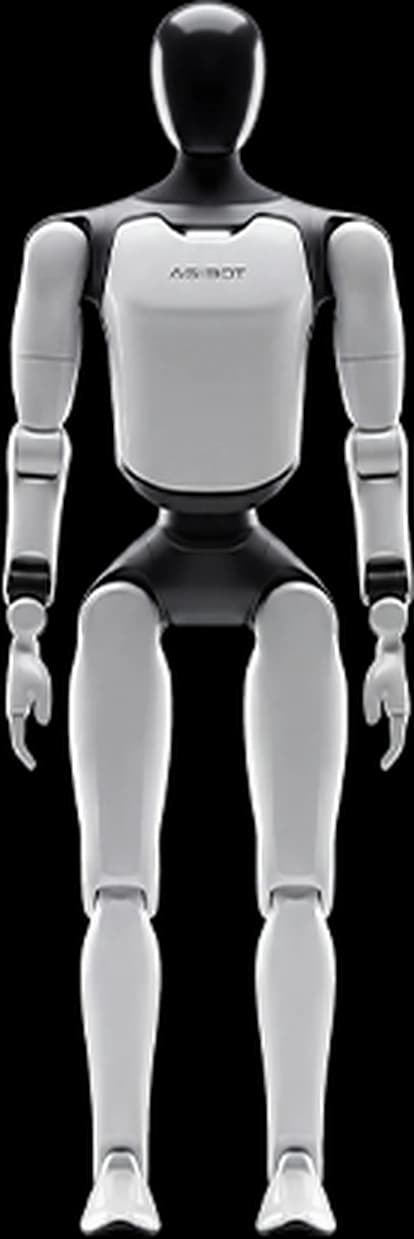
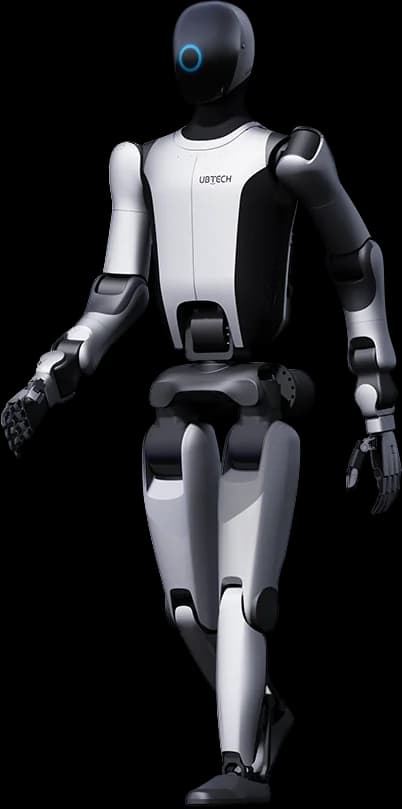
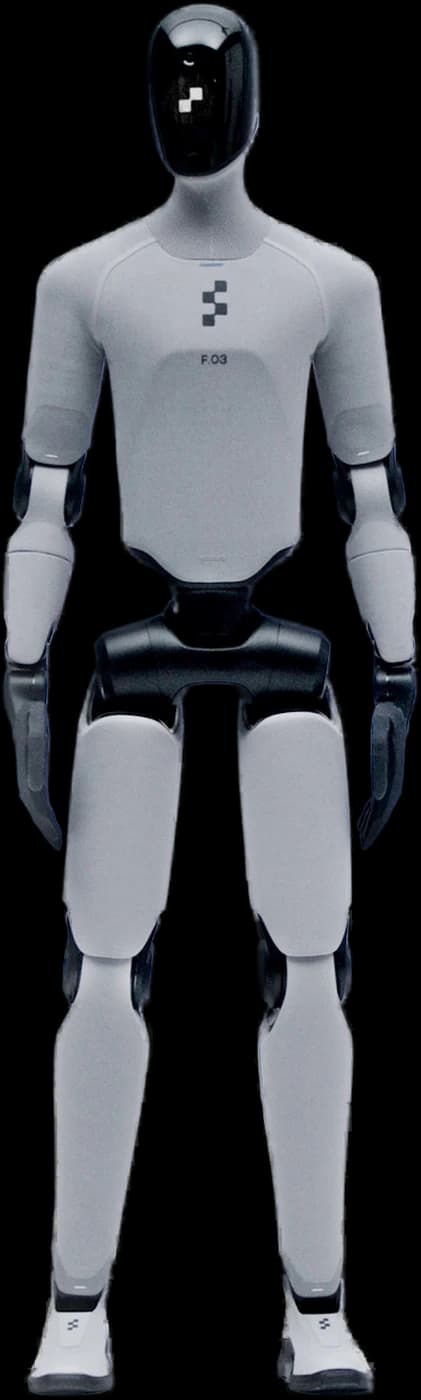
The table contains only filled, sourced values. The Unitree G1, H2 and AgiBot X1 rows come from our own catalog data (robots.ts). The comparison passes no verdict on performance or quality; DOF counts may not be given under the same definition across makers. There is deliberately no price column.
Height, mass and degrees of freedom, with sources
| Platform | Height | Mass | DOF | Source |
|---|---|---|---|---|
| Asimov 1 | ~1.2 m | ~35 kg | 25 (+2 passive toe joints) | docs.menlo.ai/asimov/1; menlo.ai/asimov |
| AgiBot X1 | 130 cm | 33 kg | 34 | Robotlar.org catalog data (robots.ts) |
| Unitree G1 | 132 cm | 35 kg | 23 to 43 | Robotlar.org catalog data (robots.ts) |
| Unitree H2 | 182 cm | ~70 kg | 31 | Robotlar.org catalog data (robots.ts) |
Accessed 8 November 2026. For open-source humanoid examples see the FAQ.
Frequently asked questions
What is Asimov 1 and who develops it?
Asimov 1 is an open-source bipedal humanoid robot design that Menlo Research publishes on GitHub at menloresearch/asimov-1. According to Menlo Research's handbook the team works across Singapore, Vietnam and the US, and Asimov was officially announced in April 2026. Robotlar.org is not affiliated with the maker; this page is an independent research report.
Does Asimov 1 have anything to do with Asimov's laws of robotics?
No. Asimov 1 is the product name of Menlo Research's robot; it has no connection to Isaac Asimov's laws of robotics. We found no explanation of the name's origin in the sources.
What are Asimov 1's specifications (height, weight, joint count)?
Per the maker: about 1.2 m tall, about 35 kg and 25 actuated degrees of freedom (legs 6x2, arms 5x2, waist 1, neck 2). Compute is a Radxa CM5 and a Raspberry Pi 5, with motor communication over six CAN channels. In our own check the 25 DOF simulation model loaded without errors in MuJoCo 3.3.7 and gave 25 hinge joints and 35.55 kg; the mesh height measured 1.254 m.
What is CERN-OHL-S?
It is the strongly reciprocal variant of the CERN Open Hardware Licence version 2; the 'S' stands for that. Per the text, making, selling and copying the hardware is free; if you distribute you must give the complete source or state where it is, and if you modify you must keep the same license (license text: ohwr.org/cern_ohl_s_v2.txt). This is not legal advice.
Which licenses does Asimov 1 use, and is commercial use possible?
Hardware files are under CERN-OHL-S-2.0, software under GPL-2.0. Per the texts neither forbids commercial use, but both carry reciprocal terms. Which file falls under which license, especially in the sim-model folder, is not clear in the repository. Consult a lawyer for a commercial decision.
How do I get an Asimov 1?
There are two routes. The maker offers a DIY kit: the order page states an estimated build time of 20 hours and the product page mentions worldwide shipping; check the maker's pages for price, delivery and shipping (menlo.ai/order, menlo.ai/asimov, 8 November 2026). We found no separate written confirmation for shipping to Turkey. The second route is self-sourcing: CAD and the fabrication manifest are open in the repository, while the identity of off-the-shelf parts sits in an external bill of materials.
Are hands included with Asimov 1?
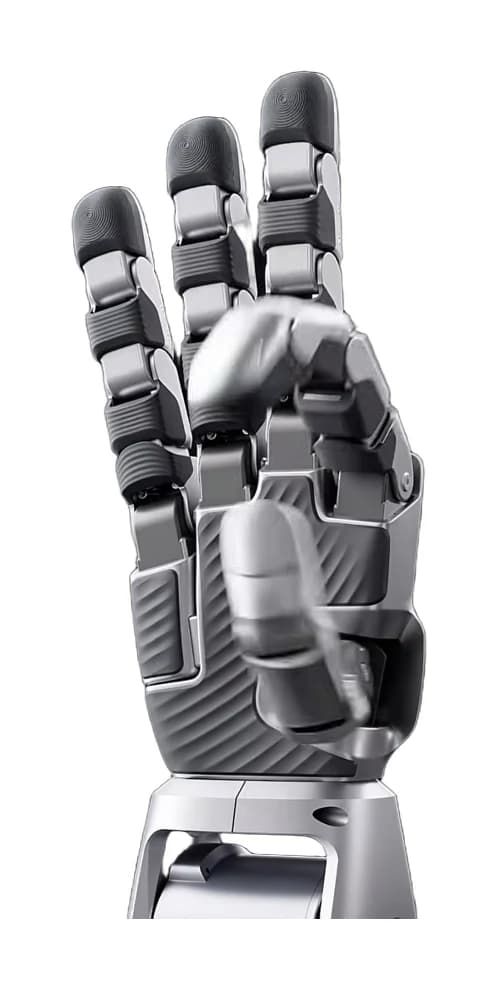
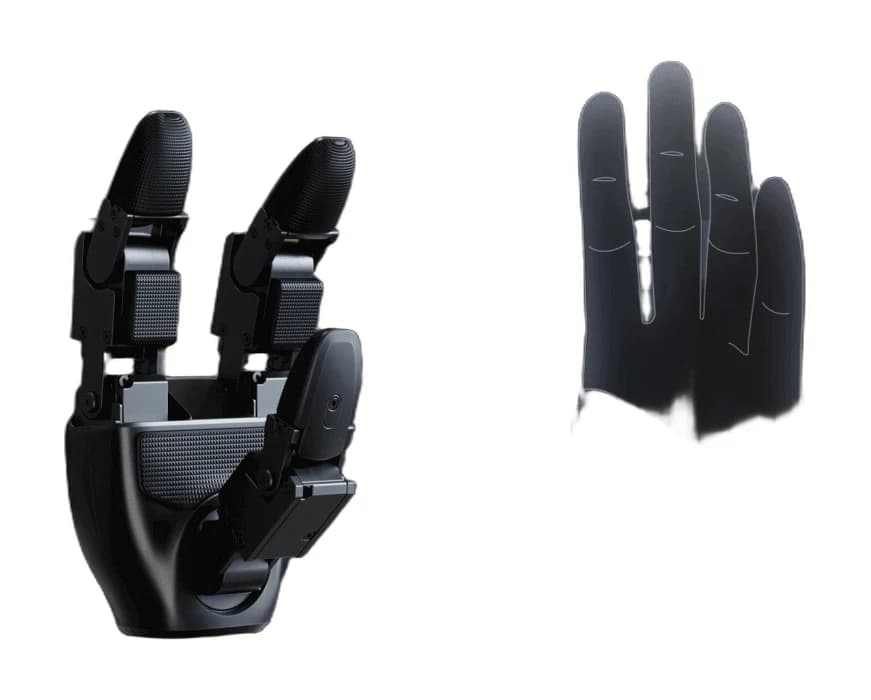
In the README's DIY kit table, 'Tools, hands' are listed as not included. The repository has no real hand CAD, only a dummy-hand print file; the 27 DOF simulation model defines a two-finger gripper. The maker's documentation says hands, tools and sensors can be added; we could not read the answer to 'Does Asimov have hands?' on the order page.
Does Asimov 1 walk, and is the software ready?
We could not verify this. On the README roadmap the walking policy and Asimov Edge are marked 'coming soon', and the repository contains no software that runs on the robot. The maker's documentation says the policy ships with the firmware; we have not seen it. The simulation video on this page is a keyframe pose animation; it does not show walking or balance.
Which open-source humanoid robots exist?
Examples we verified: Asimov 1 (Menlo Research, hardware under CERN-OHL-S-2.0); AgiBot X1 (per our catalog data 130 cm, 33 kg, 34 DoF; hardware design, inference software and RL training code are on GitHub); Berkeley Humanoid Lite (per its GitHub repository code is MIT and other assets are CC BY-SA 4.0); K-Scale K-Bot (it was open source, but per news reports the company closed in November 2025).
What is the difference between Asimov 1 and the Unitree G1?
With sourced figures: per our catalog data the Unitree G1 is 132 cm, 35 kg and 23 to 43 degrees of freedom; Asimov 1 is about 1.2 m, about 35 kg and 25 actuated degrees of freedom. Asimov 1's CAD, electrical and simulation files are open in its repository. This page makes no performance or quality comparison; DOF counts may not be given under the same definition across makers.
Sources
All sources were accessed on 8 November 2026. For live information such as price, delivery and shipping, check the maker's pages.
- 1.menloresearch/asimov-1 repository (README, mechanical, electrical, sim-model)Main source; local copy at commit 43aa368, history read through the GitHub API (accessed 8 November 2026)
- 2.HARDWARE-LICENSE.txt (CERN-OHL-S-2.0)Hardware license text (accessed 8 November 2026)
- 3.SOFTWARE-LICENSE.txt (GPL-2.0)Software license text (accessed 8 November 2026)
- 4.Asimov 1 documentation (Menlo Docs)Maker documentation: specifications, software status (accessed 8 November 2026)
- 5.Asimov 1 bill of materials (BOM)External list the README points to; not read (accessed 8 November 2026)
- 6.Menlo Research: Asimov 1 product pageShipping and service statement, height, mass, torque (accessed 8 November 2026)
- 7.Menlo Research: Asimov 1 order pageKit contents, estimated build time (accessed 8 November 2026)
- 8.Menlo Research handbook: What is MenloTeam and announcement information (accessed 8 November 2026)
- 9.asimov-mjlab12 DOF leg locomotion attempt (accessed 8 November 2026)
- 10.asimov-1-ampIsaac Lab AMP velocity tracking (accessed 8 November 2026)
- 11.Berkeley Humanoid LiteFAQ: license information (accessed 8 November 2026)
- 12.CERN-OHL-S-2.0 textOfficial license text (accessed 8 November 2026)
- 13.GNU GPL-2.0 textOfficial license text (accessed 8 November 2026)
Method
What we did: read a local copy of the repository (43aa368) and counted and parsed the manifest, schematics, PCB and device tree files, wiring CSVs, and URDF and MJCF files; read the history through the GitHub API; loaded the 25 and 27 DOF models in mujoco 3.3.7 and measured mass, joint limits and a passive drop; produced the images from simulation meshes and the diagrams from repository data. We read the maker's pages directly on 8 November 2026.
What we did not do: build the robot, measure real hardware or speak with the maker; read the 25 PDFs or the external bill of materials; do any price, cost or return analysis or legal assessment.
Every sentence marked 'inference' or 'estimate' is our own interpretation; unmarked figures come from files, GitHub records or the stated source.
Image and license note
The renders, videos and diagrams on this page were derived by Robotlar.org from the sim-model STL files and data in the menloresearch/asimov-1 repository and were processed by us on 8 November 2026. The source hardware files are under CERN-OHL-S-2.0 and the terms in the license text apply (license text: https://ohwr.org/cern_ohl_s_v2.txt). Source Location: https://github.com/menloresearch/asimov-1.
The Menlo Research name and logo belong to the maker; their use on this page does not imply endorsement or partnership. The 'M' emblem visible on the model belongs to Menlo.