






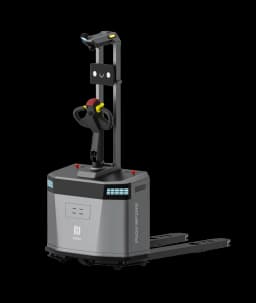
Pudu's model selection criteria
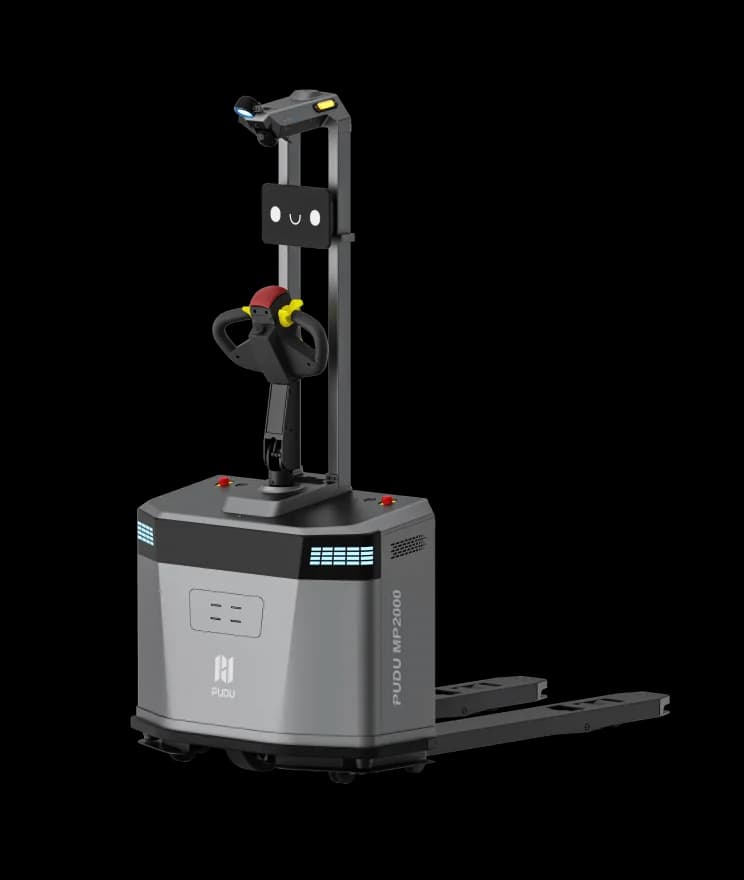
In Pudu Robotics' PUDU MP2000: Which Model is Right for you? video, the MP2000 product manager defines configuration selection in four steps:
- 0:00-0:21, configurations. The two models in the MP2000 line differ in outer fork spacing: MP2000 Standard 620 mm, MP2000 Narrow Fork 550 mm.
- 0:22-0:43, selection criterion. The configuration is determined by the pallets the customer already uses. At least 20 mm of clearance is required between the fork tines and the inner sides of the pallet openings, and at least 20 mm on the outer sides.
- 0:43-1:06, Euro pallet application. The 550 mm Narrow Fork is used with standard Euro pallets. Clearance on both sides prevents snagging on entry and damage to the inner faces of the openings, keeping operation safe and uninterrupted.
- 1:07-1:33, pallet matching. The 550 mm Narrow Fork is recommended for 1200×800 and 1200×1000 pallets, the 620 mm Standard for 1200×1000, 1100×1100 and 1200×1200 pallets. Selection follows the pallet standard actually in use on site.
Which MP2000 configuration for which pallet standard?
| Pallet standard | Recommended configuration |
|---|---|
| 1200 × 800 mm (Euro pallet) | 550 mm Narrow Fork (MPID01-N) |
| 1200 × 1000 mm | 550 mm Narrow Fork or 620 mm Standard |
| 1100 × 1100 mm | 620 mm Standard (MPID01-M) |
| 1200 × 1200 mm | 620 mm Standard (MPID01-M) |
Source: Pudu Robotics, MP2000 product manager (video, 1:07-1:28); model codes from the PUDU technical specification.
In standard operation the MP2000 enters the pallet with its 1200 mm side along the forks: a Euro pallet from its 800 mm side, a 1200×1000 pallet from its 1000 mm side. The right-angle pickup aisle figures in the technical specification are given for this orientation.
Where several pallet standards are in use, the configuration is determined by the full pallet inventory the robot will handle, not by the most common pallet. Where Euro pallets and 1100×1100 or 1200×1200 pallets move in the same flow, the fleet is built with both configurations or the flows are separated by pallet standard. Fork spacing is tied to the configuration and supplied under two separate model codes, so the fleet plan is drawn up together with the pallet inventory.
Why the 550 mm Narrow Fork for Euro pallets: the engineering
The rationale for this pairing is the Euro pallet's standard geometry. According to EPAL's technical data sheet the Euro pallet measures 1200 × 800 × 144 mm. On the 800 mm side the outer blocks are 100 mm and the centre block 145 mm wide (±3 mm), with an entry height of 100 mm; the two openings between the blocks are 227.5 mm each.
Scaled diagram: nominal EPAL dimensions, fork aligned to the pallet axis. The fork's outer edges, which govern the outer clearance check, are shown.
The outer edges of the two openings are nominally 600 mm apart. With the fork aligned to the pallet axis:
- 550 mm Narrow Fork: 25 mm of clearance remains to the outer block on each side, meeting the 20 mm criterion. Even at the least favourable combination of EPAL's ±3 mm tolerances, the clearance does not fall below 20.5 mm.
- 620 mm Standard: the fork's outer edges fall 10 mm inside the blocks on each side. Even at the widest tolerance limit the outer edges of the openings are 609 mm apart; this configuration cannot enter a Euro pallet from the 800 mm side.
On the inner side, clearance is set by the distance between the fork tines and the 145 mm centre block. The manufacturer's recommendation of the 550 mm Narrow Fork for Euro pallets confirms that the 20 mm inner criterion is also met on this pallet.
The same calculation shows that the 800 mm entry side is what decides the choice: on the Euro pallet's 1200 mm side the openings are 382.5 mm wide with outer edges 910 mm apart, and both configurations fit.
Why do both configurations suit 1200×1000 pallets?
With 1200×1000 pallets the MP2000 enters from the 1000 mm side. That side is 200 mm wider than the Euro pallet's entry side; on standard 1200×1000 pallets the openings are correspondingly wider, and the 600 mm outer clearance that rules out the 620 mm configuration on Euro pallets does not apply. In Pudu's demonstration the same 1200×1000 plastic pallet is picked up by both configurations (1:15 and 1:20).
Several designs are in use at 1200×1000: EPAL has two separate standards at this size (EPAL 2 and EPAL 3), and block and runner layouts on plastic pallets vary by manufacturer. For sites using these pallets the configuration is set by two criteria:
- The rest of the pallet inventory: if Euro pallets are also handled, the 550 mm Narrow Fork covers both standards; if 1100×1100 or 1200×1200 pallets are also handled, the 620 mm Standard is selected.
- Pallet design: the inner and outer clearance criterion (at least 20 mm) is verified against the entry dimensions of the pallets on site.
How is pallet compatibility assessed?
The pallet compatibility assessment rests on four parameters measured at the entry side from which the robot will pick the pallet:
- A, outer clearance span: distance between the outer edges of the two openings. 600 mm on a Euro pallet.
- B, centre block width: distance between the inner edges of the openings. 145 mm on a Euro pallet.
- C, entry height: from the floor to the top of the opening. 100 mm on a Euro pallet. The MP2000's lowered fork height is 80 ± 5 mm; C must exceed it.
- D, pallet type: the MP2000 supports three-runner and perimeter-base standard pallets and learns to recognise non-standard load carriers.
Outer clearance criterion: fork outer width + 40 mm ≤ A. On a Euro pallet the 550 mm configuration meets it at 590 mm; the 620 mm configuration does not at 660 mm. Inner clearance criterion: distance between the fork tines ≥ B + 40 mm.
The assessment covers the most worn pallets on site as well as new ones. On a Euro pallet the 550 mm configuration has a margin of 5 mm above the 20 mm criterion, while EPAL's exchange criteria accept twisted blocks protruding by up to 10 mm. The share of damaged and repaired pallets is therefore an input to both the configuration decision and the pallet maintenance plan.
What is the difference between the MP2000 Standard and Narrow Fork?
The two configurations differ only in fork outer width; body, payload, lift range, navigation and energy system are identical:
| Parameter | MP2000 Standard / Narrow Fork |
|---|---|
| Model code | MPID01-M (Standard), MPID01-N (Narrow Fork) |
| Fork outer width | 620 mm (Standard), 550 mm (Narrow Fork) |
| Overall dimensions | 1585 × 910 × 1870 mm |
| Max. load | 2000 kg |
| Fork height | Lowered 80 ± 5 mm, max. 200 ± 5 mm |
| Right-angle pickup aisle | 2000 mm with 1200×1000 pallets, 1960 mm with 1200×800 pallets |
| Navigation | 3D LiDAR-SLAM, VSLAM |
| Threshold and gap | 10 mm threshold, 35 mm gap |
| Gradeability | 3° at full load, 8° unloaded |
| Battery life | 12 h unloaded, 6 h at full load |
The full technical specification is on the MP2000 product page. For a comparison with forklifts and line-guided AGVs see MP2000 vs forklift, and for the difference from under-rack transport see MP2000 vs T600 Underride.
Pre-deployment technical assessment
- Entry orientation and aisle: the MP2000 picks the pallet with its 1200 mm side along the forks. The right-angle pickup aisle is 2000 mm with 1200×1000 pallets and 1960 mm with 1200×800 pallets; rack and storage layout is planned to these values.
- Alignment tolerance and entry clearance: the 15 cm offset and 15° angle are the range within which the robot detects a manually placed pallet and aligns before entry. Entry itself takes place within the clearance criteria on this page.
- 1100×1100 and 1200×1200 pallets: the 620 mm Standard configuration is recommended. As opening positions vary with pallet design at these sizes, the criteria are verified against the pallets on site.
- Non-standard load carriers: for 600 × 800 mm half pallets, custom plastic designs and special-size carriers, the MP2000's load-carrier learning capability is used, with compatibility confirmed by on-site testing.
- Floor and gradient: the 10 mm threshold, 35 mm gap and 3° full-load / 8° unloaded gradient limits are checked along the route.
Site survey, quotation and deployment
As the PUDU Robotics Turkey Distributor, Robotlar.org runs MP2000 projects under single responsibility: site survey, pallet compatibility assessment, installation and commissioning, warranty, spare parts and Turkish-language technical support. Share your pallet inventory (pallet types, quantities, entry dimensions and photos) through the quote form and a configuration proposal and corporate quotation are prepared; the final configuration is confirmed by the site survey.
Sources: Pudu Robotics, PUDU MP2000: Which Model is Right for you? (YouTube), PUDU MP2000 technical specification, EPAL Euro pallet technical data.