What is CoorDex, and what problem does it solve?
CoorDex: Coordinating Body and Hand Priors for Continuous Dexterous Humanoid Loco-Manipulation (arXiv:2606.23680, 22 June 2026; Sikai Li, Shuning Li, Zhenyu Wei, Yunchao Yao, Chenran Li, Mingyu Ding) is an independent academic paper.
It points to two constraints: (1) humanoid loco-manipulation is usually reduced to a stop-and-go process; walk to the object, stop, manipulate, then resume; (2) the end effectors used are typically low degree-of-freedom, so in practice they behave like a simple open-close grasp primitive.
CoorDex combines body and dexterous-hand control not in raw high-dimensional joint space but in a coordinated latent residual control space, making genuine finger-level manipulation possible while the robot is in motion.
The method: how are body and hand priors coordinated?
The pipeline has four steps:
- Simulated demonstrations: starting from simulated whole-body and hand motions.
- Privileged teachers: motion-tracking teacher policies are trained separately for the humanoid body and the dexterous hand.
- Distillation into latent priors: those teachers are distilled into proprioception-conditioned latent priors.
- Residual reinforcement learning: the frozen priors serve as the action space for downstream residual RL.
The key design decision is the coordinated latent residual policy: a structure that shares one task context but keeps separate residual heads for body and hand. This preserves natural whole-body motion while independently improving finger-level contact reliability.
What hardware was used? (And why that detail matters)
The hardware side is exactly why this work is directly applicable for organizations in Turkey:
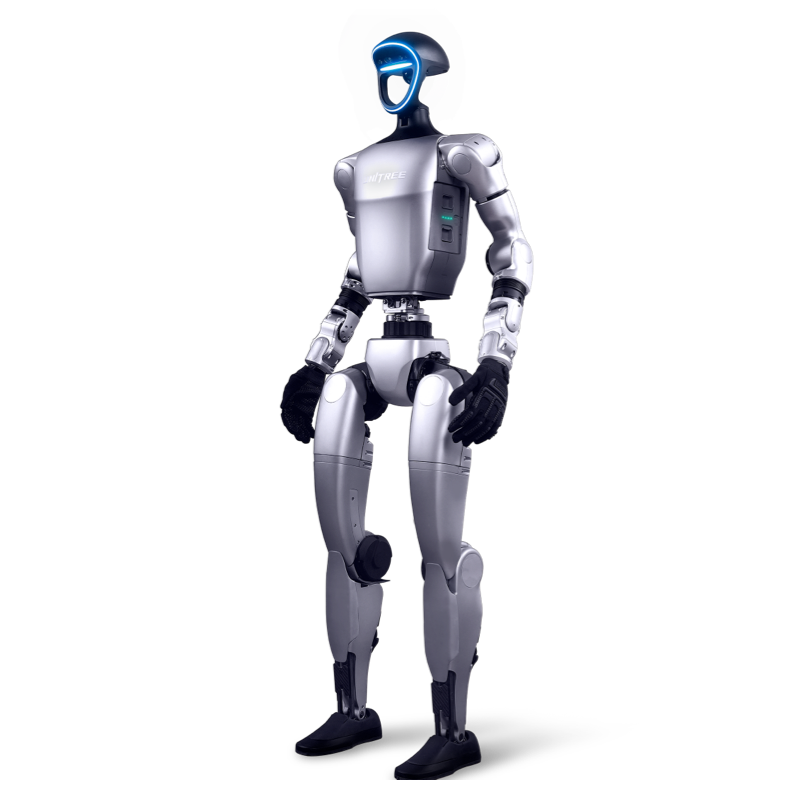
- Real-robot experiments: Unitree G1 humanoid + 7-DoF Dex3-1 dexterous hand.
- Simulation: Unitree G1 + 20-DoF Wuji dexterous hand, trained in NVIDIA Isaac Lab.
The real point: the real-robot configuration is precisely the G1 EDU setup we sell in Turkey. The EDU variant of the Unitree G1 reaches up to 43 DoF with the optional Dex3-1 dexterous hand (7 active finger DoF + 2 wrist DoF) and provides 100-157 TOPS of on-board compute via NVIDIA Jetson Orin.
In other words, the experimental setup in this paper is not a theoretical lab construct; it is a configuration you can order today. We walk through building the Isaac Lab stack end-to-end with the G1 in our G1 + NVIDIA Isaac GR00T guide.
Demonstrated tasks and results
Three loco-manipulation skills are demonstrated:
- WalkGrab, non-stop bottle grasping and carrying.
- OpenFridge, opening a fridge door while in motion (stepping back).
- WalkPickTurn, picking up a cube while walking and turning it.
The ablations compare approaches on the WalkGrab task under an identical reward budget, and report that direct joint-space PPO, joint-space hand control and monolithic latent prediction all fail; the only structure that learns the task is the coordinated latent residual policy.
For transparency: the published project page and abstract do not share a comparative table of numeric success rates; results are reported at the "learns / fails to learn" level. We therefore do not derive any percentage performance claim from it.
Why does this work matter right now?
The timing is notable. In its Gemini Robotics 2 announcement, Google DeepMind showed serious progress on whole-body control; yet in its own published measurements it wrote plainly that multi-finger dexterity remains challenging (tie trash bag 44%, dustpan 32%, ziplock 40%).
Read together, the two works point to one conclusion: the real competition in humanoid robotics is no longer "can it walk" but "how dexterously can it work while walking".
And increasingly, the platform in the hands of the researchers chasing that answer is the Unitree G1.
What does it mean for universities and R&D teams in Turkey?
The practical value of papers like this is that they provide a reproducible foundation. When a Turkish university or industrial R&D team works on the same hardware (G1 EDU + Dex3-1) and the same simulation stack (Isaac Lab, ROS 2, MuJoCo), it can reproduce published results, add its own contribution on top and publish internationally. On a closed platform, none of that is possible.
A concrete starting path:
- Hardware: G1 EDU (Jetson Orin, open SDK, optional Dex3-1 dexterous hand).
- Software stack: ROS 2 + Isaac Sim/Isaac Lab + MuJoCo; start with our G1 SDK development guide.
- Turnkey setup: the G1 R&D Platform.
- Budget/procurement: our university and enterprise robot procurement guide.
Where to start?
Robotlar.org is the official Unitree Robotics partner in Turkey. We supply the G1 and G1 EDU with official warranty, Turkish technical documentation, on-site commissioning and engineering support across Turkey, and advise your team on the right research configuration; dexterous hands, sensors and compute modules included.
To discuss your research goals, determine the right G1 configuration and get a project-specific quote, contact us.
Note: CoorDex is an independent academic work; Robotlar.org has no affiliation with the paper or its authors. Sources: arXiv:2606.23680 and the project page.