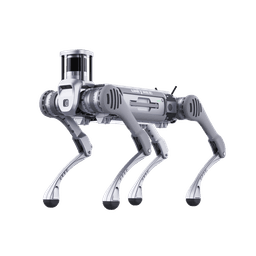
What is an explosion-proof robot dog?
An explosion-proof robot is designed so that it does not ignite an explosive atmosphere during normal operation, and it is certified for that. There are two separate things here: a robot being rugged and a robot being certified. A dust and water resistant body such as IP66 does not by itself mean the robot can be used in an explosive atmosphere. Ignition sources such as sparks, hot surfaces and batteries are handled separately.
The advantage of a four-legged robot is that it can handle most in-plant obstacles such as stairs, grating and pipe bridges. Wheeled vehicles often stop at those points. The standard Unitree B2 and the wheeled B2-W are used for industrial inspection, but they do not carry explosive atmosphere markings. That marking is published for Unitree's B2-Ex version.
What does the Ex db mb IIB T4 Gb marking mean?
Unitree's page lists Ex db mb IIB T4 Gb for the B2-Ex chassis and Ex db eb ib mb IIB T4 Gb for the inspection solution. Read the parts like this:
- Ex: Equipment designed for explosive atmospheres.
- db: Flameproof enclosure. If an explosion happens inside, the enclosure withstands it and stops the flame from passing out.
- mb: Encapsulation. Parts that could ignite are sealed in a compound that separates them from the atmosphere.
- eb and ib: Extra protections in the inspection solution: increased safety and intrinsic safety (low-energy circuits).
- II and B: II is the equipment group for surface industries. B is the gas subgroup and covers gases such as ethylene. IIB equipment can also be used with IIA gases. Hydrogen and acetylene belong to IIC, so a IIB marking is not enough for them.
- T4: Temperature class. Surface temperature does not exceed 135 °C. Suitable for gases whose ignition temperature is above that.
- Gb: Equipment protection level. By definition it corresponds to Zone 1 and Zone 2, not Zone 0.
In short, the marking says the B2-Ex is designed for Zone 1 and 2 areas where IIB or IIA gases may be present. For an area with hydrogen or acetylene, this marking is not sufficient.
What is ATEX and what applies in Turkey?
ATEX is the European framework for equipment used in explosive atmospheres. Its Turkish counterpart is the regulation on equipment and protective systems intended for use in potentially explosive atmospheres, published in 2016 and harmonised with 2014/34/EU. It classifies equipment by group and category, and for electrical equipment used in Zone 1 it requires EU-type examination by a notified body.
In practice the marking alone is not enough. The operator and the safety engineer will usually want to see three things:
- The certificate number.
- The body that issued the certificate (the notified body).
- The standard or scheme it was issued under (ATEX, IECEx or another scheme).
Unitree's B2-Ex page shows the marking, but these three items are not on it. Whether a Chinese or IECEx-only certificate will be accepted by a given operator also needs to be clarified. So we request the certificate from the manufacturer and review it before a project starts. If the certificate does not match your site's zone classification, we do not claim use in that zone.
What are the Unitree B2-Ex specifications?
The values below are manufacturer statements from Unitree's B2-Ex page. The body and the inspection solution (with its superstructure) are given separately where they differ.
| Feature | B2-Ex (manufacturer stated) |
|---|---|
| Protection rating | IP66 |
| Weight | Body 130 kg, inspection solution about 170 kg |
| Payload | 40 kg continuous, 70 kg maximum |
| Runtime | Body at least 7 hours, inspection solution with 40 kg at least 4 hours |
| Battery | 60 Ah, 3072 Wh |
| Slope | Body 45 degrees, with superstructure 30 degrees |
| Speed | 0 to 1 m/s on the product page (the inspection tab says 0 to 2 m/s) |
| Operating temperature | -20 to 55 °C |
No independent field measurements of these figures have been published. Runtime, payload and slope usually come in below brochure figures in the field. We confirm the real runtime for your site, floor and temperature with a pilot round. For the general figures of the standard B2, see the B2 product page.
Which sensors come with the inspection solution?
According to Unitree, the B2-Ex inspection solution includes a bi-spectrum (thermal and visible) PTZ camera as standard. The thermal image can show hot spots, overheating equipment and temperature differences caused by leaks. The visible camera confirms the same point with a normal image. Unitree's page does not give specifications for this camera. Resolution and zoom figures are confirmed per project for the chosen configuration.
Gas measurement is part of most projects too. Which gas is measured (combustible gas, H2S, CO and so on), the measuring range and the sensor's own Ex certificate are set per project. When a new sensor is added to the robot, the robot's marking alone is not enough. Each added part's own certificate and the suitability of the overall configuration are checked separately. For the thermal side, see our thermal camera robot dog guide.
Where can the B2-Ex be used?
Sites with a risk of explosive gas or vapour, whose zone classification matches the marking, can be candidates:
- Petrochemical and refinery: Pump, valve and pipeline rounds, temperature anomalies and gas readings.
- Natural gas facilities: Regulator stations, compressor areas and leak checks.
- Chemical plants: Solvent storage and filling areas.
- Energy facilities: Fuel and natural gas lines, see energy line inspection robot.
Underground mines are a separate case. Underground workings with firedamp (methane) risk require Group I equipment, while the B2-Ex marking is for Group II, so it is not sufficient for underground galleries. For robot use on mine sites, see mine site robot solutions.
In most of these sites the goal is to move regular rounds in hazardous zones from people to the robot. The robot walks the route and raises an alert on an abnormal reading. The decision stays with a person.
How does it compare with alternatives?
Certified legged robots for explosive atmospheres are few. One known example is ANYbotics ANYmal X. According to the manufacturer's page, ANYmal X has an ATEX EU-type examination by Bureau Veritas: Zones 1 and 2, gas group IIB, T4, category 2G. The same page says IECEx certification will be available with first production.
So the two robots carry markings in the same class. The difference is how transparent the certificate is. For ANYmal X the notified body is published. For the B2-Ex this information is not on Unitree's page and has to be verified per project. When deciding, look less at the class of the marking and more at the certificate itself, and at your site's zone and gas group. For standard inspection packages, see Unitree industrial packages.
What does Robotlar.org do in a B2-Ex project?
We have already carried out many similar field integrations with Unitree robots. Depending on your project, we take on the following:
- Suitability pre-check: Comparing the site's zone, gas group and temperature class with the marking.
- Certificate sourcing: Requesting the certificate number, notified body and standard from the manufacturer and sharing them with you.
- Configuration: Choice of camera, gas sensor, payload and charging setup.
- Data architecture: Offline operation design so mission data stays on the site network as far as possible, see offline robot dog data security.
- Training and service: Operator training, commissioning and maintenance.
If the Ex certificate cannot be verified, we do not claim use in an explosive atmosphere. The same robot can still do standard inspection in areas without gas risk. For a quote and delivery time, fill in the quote form and we will clarify your site's conditions together. For lighter platforms, see the Unitree A2 and As2 pages.