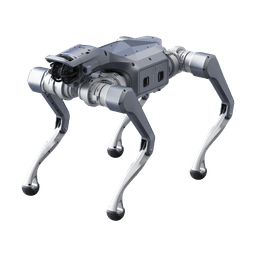
What are Unitree industrial packages and which versions exist?
An industrial package combines a quadruped platform with mission payloads (cameras, sensors, an arm) and inspection software. Unitree's smart inspection page lists four versions:
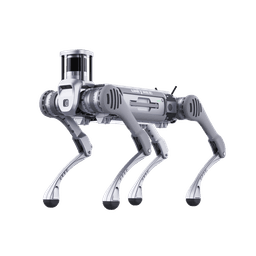
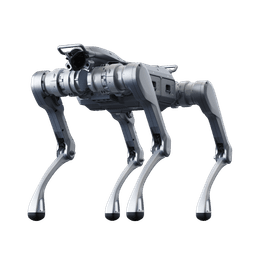
- B2 Industrial: based on the Unitree B2, built for heavy payloads and long missions.
- B2 Explosion-Proof: a heavier B2 body carrying hazardous-area markings.
- A2 Industrial: based on the Unitree A2, a mid-size and agile option.
- As2 Industrial: based on the Unitree As2, light and quick to deploy.
The "Industrial" names appear only on the inspection page tabs. Product pages use B2, B2-W, B2-Ex, A2, A2-W and As2. When ordering, the platform model and the payload list are specified separately.
How do the four industrial versions compare on paper?
The figures below come from the tab summaries on Unitree's inspection page. They are manufacturer-stated and best read as a marketing summary; no independent field measurements have been published.
| Version | Continuous payload | Slope | Step | Cruise speed | Endurance |
|---|---|---|---|---|---|
| B2 Industrial | 40 kg or more | 45° | 25 cm | 0-2 m/s | 4-6 h |
| B2 Explosion-Proof | 40 kg or more | 45° | 25 cm | 0-2 m/s | 5-7 h |
| A2 Industrial | 25 kg or more | 40° | 30 cm | 0-2 m/s | 3-5 h |
| As2 Industrial | 15 kg or more | 40° | 25 cm | 0-2 m/s | 2.5-4 h |
Some product page figures differ from the tabs:
- B2: about 60 kg, IP67, 2250 Wh battery, over 5 h unloaded. The B2 manual gives under 20° slope in regular mode and under 45° in AI mode, low gear.
- B2-Ex: 130 kg body, about 170 kg as an inspection solution, IP66, 40 kg continuous and 70 kg maximum payload. Its product page lists 0-1 m/s.
- A2: about 42 kg, IP56, dual hot-swappable batteries. Its product page lists a 45° slope.
- As2: about 20 kg. The 15 kg continuous payload applies to X and EDU, PRO carries 13 kg; these three are rated IP54. The AIR version carries 10 kg and has no IP rating.
Loaded endurance in the field is lower than the brochure. We plan missions on measured values.
When do the wheeled B2-W and A2-W make sense?
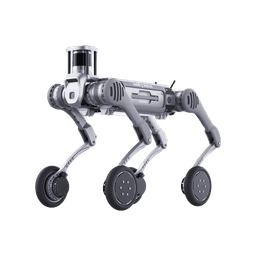
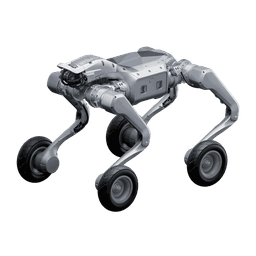
All four inspection tabs are legged models. Where routes are long, the wheeled-legged variants are worth considering:
- Unitree B2-W: about 85 kg, IP67. Manufacturer-stated range is 25 km with 40 kg and about 30 km unloaded. A fit for large perimeters, long line patrols and mostly paved sites.
- Unitree A2-W: about 52 kg, IP56. Manufacturer-stated figures are over 3.5 h and about 35 km unloaded, over 1.5 h and 15 km with 25 kg. A balanced choice for urban areas, mixed ground and buildings with stairs.
Wheels add speed and range on flat ground. On rubble, loose soil and frequent stairs the legged version is the safer choice. We decide after a site survey based on the ground mix.
What does the thermal dual-sensor T-type gimbal offer?
This is the most complete camera payload in the catalogue. Manufacturer-stated specifications:
- Thermal: 640x512 resolution.
- Visible: 4 MP camera with 32x optical and 16x digital zoom.
- Temperature range: -20 to 550 °C.
- Accuracy: ±2 °C or ±2%.
Typical uses are hot spots on transformer connections, panels, cable terminations, motors and bearings. It also helps with people and heat source detection on night patrols. Stabilization, the camera maker and the video output are not published. One dealer's inspection package shows a gimbal with 25x optical zoom, so more than one variant may exist. We pin down the exact variant in writing at the quote stage. See our thermal camera robot dog guide for more.
What are the acoustic camera, gas sensor, 3-axis gimbal and robotic arm for?
- Acoustic imaging camera: a 64 or 128 channel MEMS microphone array that places sound on the image. Cameras of this type are commonly used to find compressed gas and air leaks and electrical partial discharge.
- Gas sensor: manufacturer-stated detection of HF, Cl2, PH3, AsH3, B2H6 and F2 at ±3% of full scale. These gases are mostly found in semiconductor and chemical plants. If you need other gases, the sensor is chosen per project.
- Thermal imaging 3-axis stabilized gimbal: Unitree lists only the name, with no published specifications. Figures are obtained from the manufacturer at the quote stage.
- Dexterous robotic arm: listed as "multiple options" with no model named. It can be considered for turning valves, opening doors and taking samples; capability is confirmed for the chosen model.
Important: the payload list is shared across all platforms and no compatibility matrix is published. We confirm in writing with the manufacturer, project by project, which payload fits which platform.
Which version fits which job?
- Substation and power plant inspection: B2 Industrial or B2-W with the dual-sensor gimbal and acoustic camera, for long routes and heavy payloads. See the energy line inspection guide.
- Oil, gas and chemical sites: B2 Explosion-Proof with the gas sensor. Not used in hazardous areas until Ex certificate details are verified.
- Security and perimeter patrol: B2-W on large flat sites, A2-W on mixed ground and stairs. Security teams and critical infrastructure operators can start with the security patrol guide.
- Search and rescue: A2 or As2 for rubble and tight passages. As2 is easy to carry in a vehicle; A2 takes more payload. See the search and rescue robot guide.
- Tunnels, galleries and mines: B2 or A2 with LiDAR-based mapping. Underground work needs relay nodes or a fibre link. See the tunnel and cave mapping guide.
Torn between As2 and B2? Read our As2 vs B2 comparison.
Can the B2 Explosion-Proof be used in hazardous areas?
Unitree's own page shows the marking "Ex db mb IIB T4 Gb" for the body and "Ex db eb ib mb IIB T4 Gb" for the inspection solution. Equipment protection level "Gb" corresponds by definition to Zone 1 and Zone 2. Gas group IIB does not cover hydrogen or acetylene (IIC).
The certificate number, the issuing body and the standard (ATEX, IECEx or other) are not in any published source. Turkey's ATEX regulation is aligned with the EU directive, so the safe route is an EU-type examination certificate from a Turkish or EU notified body. We request these documents from the manufacturer for every project and do not recommend hazardous-area use without them. More in our explosion-proof robot dog guide.
What does Robotlar.org do in the integration, and how is data handled?
We have delivered most of these integrations in the field. Depending on the project we take on:
- Site survey: ground, slopes, stairs, route length and hazardous-area class.
- Platform and payload selection: with written compatibility confirmation from the manufacturer.
- Software: autonomous routes, charging plans, alarm rules and links to existing SCADA, VMS or maintenance systems.
- Data architecture: Unitree's inspection platform sends data to a control centre, but where it is hosted is not published. For sensitive sites we build an architecture that connects the mission camera to a separate mission computer and an on-premises server. This is an architecture choice, not a robot property. The robot's own cameras and microphone remain under Unitree software, and we handle them separately. Network traffic is measured during testing; a measurement only speaks for the configuration and period tested. See offline robot dogs and data security.
- Training, service and spare parts: on-site support in Turkey. For multi-robot operations see the fleet management guide.
Pricing depends on the configuration. Tell us the platform, payloads and service scope through the quote form.