Do large scale robot dog fleets actually exist today?
The largest legged robot fleet we could find in public sources is the Indian Army's 100 MULE robots, associated with AeroArc and inducted in 2024 for high-altitude logistics and surveillance. No security or rescue fleet of several hundred robots has been documented publicly.
The best documented multi-robot operations come from competitions. CERBERUS, winner of the DARPA SubT final (2021), fielded four ANYmal robots with an aerial vehicle and a tracked vehicle. CSIRO Data61 built shared maps with Spot and tracked robots. Their lessons apply directly to a large fleet: what decides success is not the number of robots but communications and logistics.
A "robot dog army" is therefore not a purchase decision. It is a system built in stages, and the sections below take it apart piece by piece.
Which robot dog models suit a fleet?
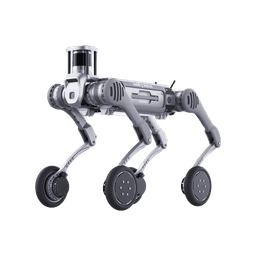
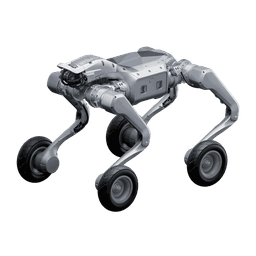
In a fleet that patrols large areas or inspects long lines, range directly sets how many robots you need. That is why wheeled-legged models stand out: they roll fast and efficiently on flat ground and step over stairs and obstacles with their legs. Figures below are manufacturer-stated. No independent field measurements have been published, and field endurance should be planned below brochure values.
| Model | Weight | Continuous payload | Range (manufacturer-stated) | Protection | Fleet role |
|---|---|---|---|---|---|
| Unitree B2-W | about 85 kg | over 40 kg | about 30 km unloaded, 25 km with 40 kg | IP67 | Heavy payload, relay carrier, long lines |
| Unitree A2-W | about 52 kg | about 25 kg | about 35 km unloaded, 15 km with 25 kg | IP56 (higher on PRO) | Main patrol and inspection body |
| Unitree As2-W | compact | 16 kg | over 30 km unloaded, about 25 km with 16 kg | IP54 | Light scout, tight spaces, fast transit |
Legged versions have a place too. The B2 is IP67 rated with quick battery swap and over 40 kg payload, according to the manufacturer. The A2 uses dual hot-swappable batteries. The As2, at about 20 kg, can be carried by one person. On rock, rubble and in caves, where wheels do not help, a legged body is the better choice. See our industrial packages guide for model selection.
What does a six-layer fleet architecture look like?
As the robot count grows, responsibilities need to be split into layers instead of left to a single piece of software. Our reference architecture has six layers:
- 1. Robot edge: The walking platform is driven through the local SDK. The mission payload runs on a separate mission computer (on the B2, Orin NX class modules can be added, per the manufacturer). Cameras, thermal camera and LiDAR connect to it. Recordings sit on encrypted storage, with remote wipe and automatic wipe after a prolonged link loss.
- 2. Tactical communications: Self-organising mesh (MANET) in open areas, private 4.5G/5G at fixed sites, dropped relay nodes in tunnels and caves.
- 3. Autonomy on link loss: Each robot maps on board and switches to a predefined behaviour when the link drops.
- 4. Mapping and map merging: Robot submaps are merged into one map at the centre.
- 5. Fleet command and control: Tasking, map server, evidence-grade video management, key management, health and spares tracking. Installed on-premise.
- 6. Security operations: Outbound traffic blocked by default, continuous traffic capture, penetration testing of every software release before use.
Where the data goes is not answered by a robot feature. It is answered by this architecture plus independent measurement. A measurement shows what happened in the tested configuration during the test, which is why monitoring is continuous. The robot's own cameras and, depending on the model, microphone run under manufacturer firmware; they are either disabled or reported with measurement results. Details are in our offline operation and data security guide.
How does a fleet keep working when communications drop?
Radio is the weakest link. Tunnels behave like waveguides: NIST measurements put the best band for subway-sized tunnels at roughly 400 MHz to 1 GHz. Natural caves, with bends and irregular cross-sections, usually lose signal faster.
SubT teams solved this in three ways:
- Relay dropping: In CERBERUS, each carrier robot could hold four relay nodes, each weighing 245 g with about 2 hours of battery.
- Store-and-forward: CSIRO's software sent live video on a best-effort basis and carried maps and detections over delay-tolerant transport. When one robot fell, another robot passing by carried its data home.
- Link safety behaviour: After a set number of failed pings, the robot retreats, and it returns home when its time budget runs out.
Know the limit up front: in a cave, live video does not reach base beyond the last relay. Maps and detections arrive once the link is restored. Autonomy should be limited to sensing and mapping, and any action affecting people should require human approval. See our tunnel and cave mapping guide.
How do you calculate battery, maintenance and spares logistics?
The math starts with batteries. The manufacturer states 4 to 6 hours for the industrial B2. About 3 hours under load in the field is a more realistic plan. At DARPA SubT, Spot managed 40 to 45 minutes in the field and ANYmal 80 minutes; brochure figures are not field figures.
- Battery packs: A 12-hour shift needs 3 to 4 packs per robot. For 200 robots that is 600 to 800 packs, plus in-vehicle charging racks, depot charging and lithium handling training. Relay nodes need charging too.
- Three maintenance tiers: The field team swaps batteries, feet, covers and payloads. A regional service depot handles joint modules, LiDAR and diagnostics. Board-level repair goes to the manufacturer.
- Spares pool: Start with spare robots equal to 10 to 15 percent of the fleet. Manufacturers do not publish MTBF, so update the ratio with pilot data.
- Logging: CSIRO saw motor burnouts in autonomous runs. Log joint temperatures from day one.
Per manufacturer figures, wheeled-legged models cover more distance per battery, which cuts pack and charging needs. That makes the B2-W and A2-W attractive for long patrol routes.
How many operators and technicians are needed, and how is training set up?
A sample team structure: 4 robots and 2 operators per team, 1 technician for every 2 teams. At that ratio, 200 robots means about 50 teams, 100 operators and 25 technicians, before shift rotation. At SubT, CERBERUS needed a 4-person crew just to prepare its robots.
At this scale you need a permanent training academy:
- Operator module: Robot handling, payloads, link loss procedures.
- Technician module: Field maintenance, battery safety, diagnostics.
- Team leader module: Mission planning, use policy, evidence-grade record keeping.
- Train-the-trainer and a training ground: A site that resembles a tunnel or cave. The CERBERUS team names frequent field testing as a key lesson.
How do you plan a phased rollout to a full robot fleet?
Nobody jumps to a large fleet in one step. Each phase needs a measurable gate:
- Phase 0, pilot (2 to 4 robots): Lab and controlled field. Gate: acceptance criteria met, no unauthorised outbound connection observed in independent traffic measurement, thermal and visible video delivered end to end, endurance and terrain performance measured.
- Phase 1, 20 robots (5 teams): An urban site plus at least one tunnel or underground site. Gate: relays and store-and-forward working, maps merged from at least 4 robots, failure and spares consumption measured, operator training validated.
- Phase 2, fleet: Delivered in batches. Gate: total cost of ownership validated with pilot data, depot capacity ready, legal and personal data framework approved, supply chain risk accepted at management level.
For a pilot model and configuration proposal, describe your needs through the quote form.
What are the main risks of a large robot fleet?
- Jamming: Mitigated with frequency-hopping encrypted waveforms and autonomy that keeps working on link loss.
- Capture of a robot: Encrypted storage, remote wipe and minimal data kept on the robot.
- Supply chain: Single-vendor dependence is a real risk. The US Department of Defense added Unitree to its 1260H list in June 2026; the list is not an export ban. In a 30 July 2026 announcement, the US FCC said it had added "advanced robotic devices", covering humanoid and quadruped mobile robots, to its Covered List. Their effect on spare parts flow and on possible future restrictions should be assessed at project start. Ask in writing for the make and model of sub-supplier parts (LiDAR, thermal core) too.
- Software updates: Every vendor update goes through independent analysis, isolated testing and staged rollout.
- Public acceptance: The New York Police Department ended its "Digidog" lease early in 2021 after backlash over surveillance and militarisation. The lesson: write the use policy, the personal data assessment, speed limits near crowds and safety distances before robots go into the field.
- Explosive atmospheres: Unitree's page shows Ex marking for the B2 Explosion-Proof, but the certificate number and issuing body must be confirmed per project. See our explosion-proof robot dog guide.
What does Robotlar.org take on in a fleet deployment?
Robotlar.org sells, integrates and services robot dogs in Turkey as a Unitree partner. In fleet projects we take on:
- Payload integration: thermal and visible cameras, LiDAR, mission computer. Thermal options are covered in our thermal camera robot dog guide.
- On-premise fleet command and control software, map merging and video management integration.
- The communications layer: mesh network, relay nodes and store-and-forward.
- Battery, spares and maintenance planning; operator and technician training.
- Measurable acceptance tests in the pilot phase.
We have built most of these integrations in the field. Model, certification and configuration details are confirmed separately for each project. For pricing and a delivery plan, reach us through the quote form.