




Why reel cutting
A rotary blade cuts by flinging the grass; a reel unit runs rotating blades against a fixed bedknife and cuts like scissors. The difference shows on the surface: reel cutting leaves a cleaner cut tip and a more uniform texture. That is why golf and professional football grounds stay with it.
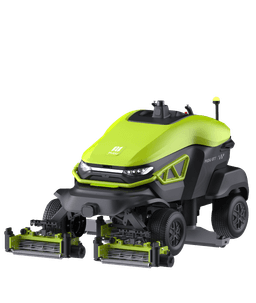
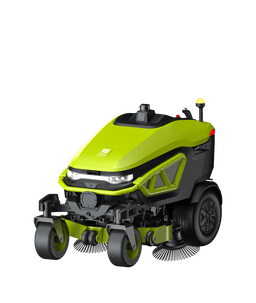
The Pudu GT7 does this with a triplex reel unit: 1600 mm width of cut, 5-50 mm height of cut and a choice of 8 or 11 blades per reel. Cutting height changes in minutes with a toolless adjustment knob, so applying different heights before and after a match adds no operational burden.
Uniform height of cut on undulating turf
No part of a pitch is perfectly flat. A single-piece cutting unit rides high or digs in when the ground undulates, and both leave marks on the surface. On the GT7 three cutting units float independently and articulated suspension tracks ground contours closely. The result is a height of cut (HOC) that stays constant even on highly undulating turf.
Striping is a question of accuracy
Striping is not decoration but repeatability: the pattern comes out clean when lanes do not drift from pass to pass. On the GT7, RTK, LiDAR and vision fusion give ±2.5 cm positioning accuracy, pushing lane drift below what the eye catches.
The pattern itself comes from path planning: cutting angle, directional rotation and lane offset are configurable, and the robot builds the route from those settings. What is an operator skill when done by hand becomes a configuration here.
Several fields, one machine
Most sports facilities have more than one field: the main pitch, training grounds, side areas. The GT series transits between them on its own along pre-mapped internal routes and resumes mowing on arrival. There is no need to load the machine onto a trailer.
On the fleet side, live location, task progress and system health are tracked remotely with instant error notifications, reducing the need for the grounds manager to check each machine on site.
Working while the facility is open, and safety
When the maintenance window is tight, machine noise becomes the constraint. The GT7's all-electric chassis runs quietly, and with the suction motor off in non-collection mode it becomes near-silent, making early morning and evening mowing possible while the facility is open.
For safety, surround-view RGB, RGBD, ultrasonic sensors and LiDAR together give 360° awareness. AI vision algorithms recognize turf boundaries, pedestrians and vehicles, applying stop, wait or bypass as appropriate. The GT5 additionally detects drop-offs such as water shorelines, steps and steep embankments, rerouting together with digital no-go zones.
Choosing by facility
Stadium, professional football and golf grounds: the GT7. If cut quality and striping are contractual, there is no alternative. Its 30° slope capability covers rolling terrain.
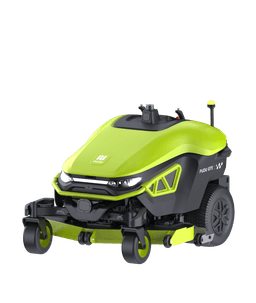
Training facility, campus and large park: the GT5. A 1.52 m deck, 8,000 m² per hour and 65,000 m² per charge close wide areas fast, with collection included.
Small pitch, residential and campus grounds: the GT3. Enough for areas up to 2 hectares, and with its blades disabled it becomes a walkway sweeper, so it earns its keep outside the mowing season too.
For a side-by-side comparison see GT3 vs GT5 vs GT7, for budget items robotic mower prices, and for the whole series on one page the robotic mower overview. Product pages: GT7, GT5, GT3.