The Study in Brief
The paper's authors are Siyuan Hu, Abulikemu Abuduweili, Yue Meng, Shipeng Liu, Quentin Leboutet, Chen Chen, Matthias Müller and Vladlen Koltun; the project page attributes the work to Apple. HALO aims to carry out a natural-language request given to the robot (for example, walking to a chair and sitting down) using only the image from the robot's own camera.
The skills taught in the paper are sitting, going to a named object, sidestepping through a half-open door, crouching under a table, crawling beneath a table and pushing a box. The system can also chain these skills to carry out longer tasks.
Data Generated in Simulation
The core idea of the work is that training data scales with compute rather than human labor. According to the paper, data pairing vision, language and motion was synthesized across a thousand procedurally generated virtual homes. Generating this data took 48 hours on 250 H100 GPUs. The motion generator was trained on 64 B200 GPUs and the motion tracking policy on 4 H100 GPUs. According to the paper, the system never saw a real home during training and transferred to the physical world zero-shot, without additional training.
How the System Works
HALO has three layers:
- Orchestrator: splits the user's request into subtasks and runs about every two seconds. According to the paper, it uses the Qwen3.6-35B-A3B model, run in 4-bit with Apple's MLX framework, on a Mac mini (M4 Pro, 64 GB) mounted at the robot's back.
- Motion generator: produces a whole-body motion plan from the camera image and the current subtask about three times per second; it also runs on the Mac mini.
- Motion tracker: turns the plan into joint commands 50 times per second and runs on the robot's factory Jetson Orin NX computer.
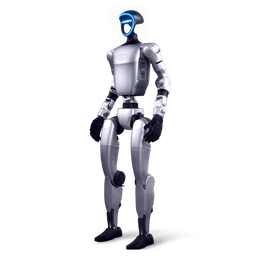
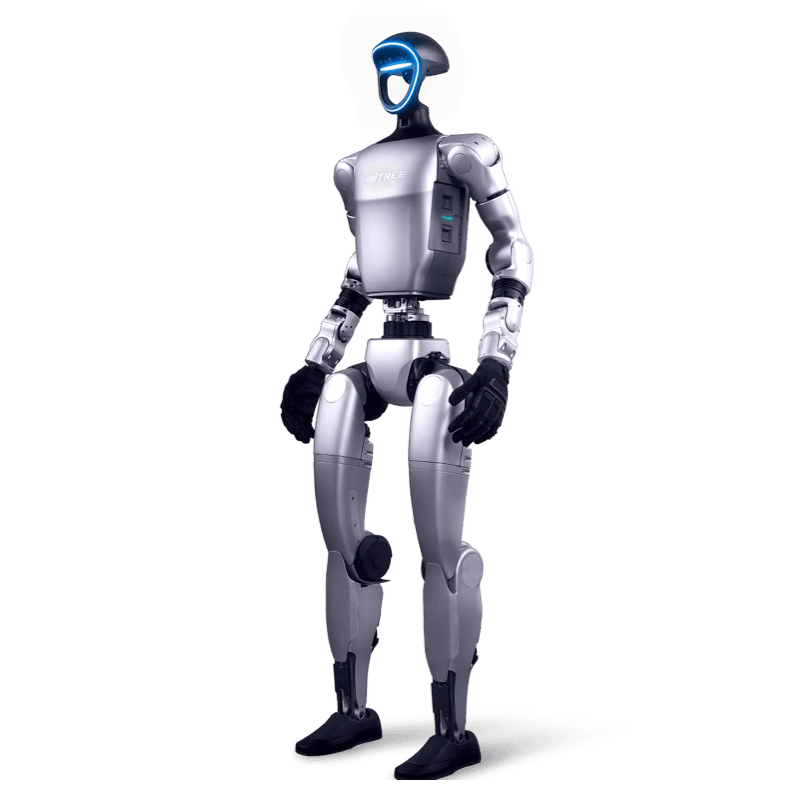
The researchers made two additions to the G1: a head-mounted wide-angle OAK-1W camera and a rear enclosure carrying the Mac mini. For depth, the robot's factory downward-facing Intel RealSense D435i camera was used.
Results and Limits
According to the table in the paper, the average single-task success rate is 91% both in simulation and in the real world. The real-world tests cover 6 skills, 6 environments and 10 trials each, for 360 trials in total. In tasks that chain several skills, the average real-world success rate drops to 70%, and these tests were run in a single environment.
The authors are also clear about the limits: adding a new physical task still requires a person to write its task description and author keyframes; because the robot's perception relies largely on vision, contact is not sensed directly; and the orchestration layer is relatively simple.
According to the project's GitHub repository, the code for data generation, model training and deployment has been published on GitHub under Apple's own license text. Teams that want to use the code should review the terms in the license file first.
What It Means for Turkey
The work shows that a research team at a large technology company also used a commercially available platform in its humanoid robot experiments. For university labs and R&D teams in Turkey, the notable point is that a published method and code for transferring simulation-generated data to a real robot can be examined. Reproducing similar work requires a robot with developer access, additional compute and substantial GPU resources, and how well the results carry over to other environments has to be tested separately.
Robotlar.org is the official Unitree distributor in Turkey; it has no connection with the HALO work or with Apple. For technical details on the G1, see the Unitree G1 page; for the development environment, the Unitree G1 SDK development guide; and for the research edition, the G1 EDU page. Other G1 related news: NVIDIA GR00T 2 and Isaac Lab 3 and the Joyson robotic brain backpack.