Loading Dock Safety and Truck Docking Distance Inspection
Scenario record: it defines the environment, the mission flow and a proposed hardware and software configuration. The list below is a configuration proposal, not an installation inventory. Field projects lists deployed systems and their measurements.
- Environment
- Indoor, public area
- Operating mode
- Supervised autonomy
- Proposed robot
- Unitree AS2
The problem addressed
Dozens of annual forklift accidents at loading docks and product damage from falling between truck and dock due to improper docking.
Draft mission flow
- 1The robot patrols along loading docks; measures each truck's docking distance and angle in real-time with LiDAR and ultrasonic sensors.
- 2Gives instant warning via speaker when non-standard docking angle or dangerous gap between dock leveller and truck bed is detected.
- 3Detects safety boundary violations of forklift operators working at dock edge and reports to OHS system with video and coordinates.
- 4Daily loading efficiency report (average wait time, docking quality, violation count) transmitted to TMS.
Proposed hardware
- 3D LiDAR
- HD Optical Camera
- Ultrasonic Distance Sensor
- High Decibel Speaker
Proposed software
- Navigation
- Dynamic SLAM around loading dock avoiding truck and forklift traffic
- Model
- Truck Docking Angle Calculation and Dock Gap Risk Analysis
- Integration
- TMS (Transport Management System) and OHS Camera Network
The robot's real operating limits
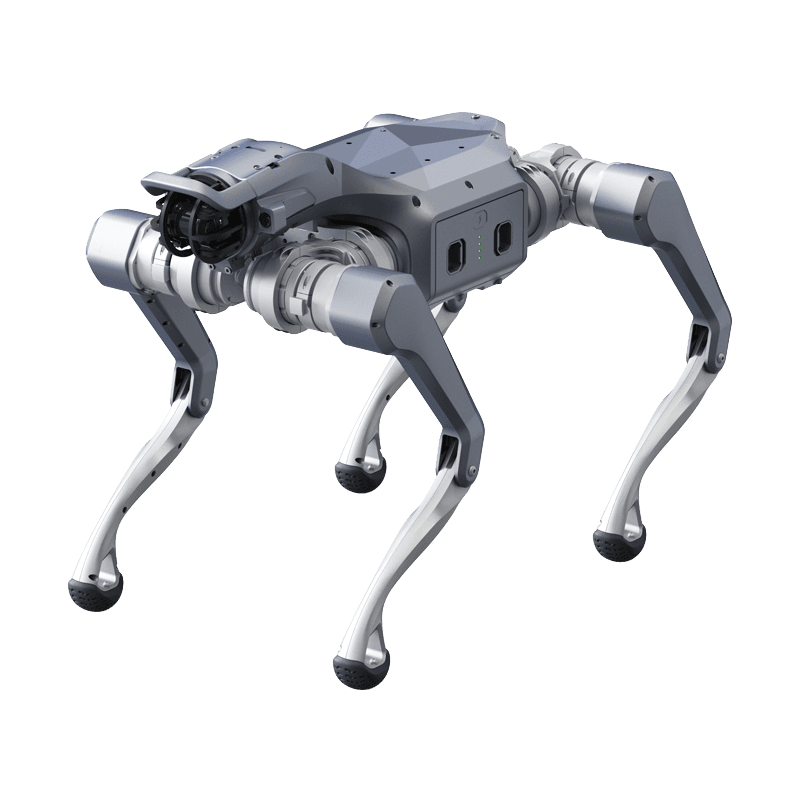
Unitree AS2
Compact industrial robot dog
Product page- Ingress rating
- IP54
- Runtime
- >4 hours (No load)
- Operating temperature
- -20°C to 50°C
- Payload
- Up to 65 kg
- Max speed
- >5 m/s
- Climb
- 40°
Values are manufacturer data. Scenario fit is determined by comparing these limits with site conditions.
From scenario to installation
Feasibility is determined by the site survey: floor and route, network coverage, the charging point, intervention responsibilities and the conditions under which the robot must stop. The survey report defines the scope, the constraints and the commissioning steps.