Parking Floor Vacancy Updater and Guidance
Scenario record: it defines the environment, the mission flow and a proposed hardware and software configuration. The list below is a configuration proposal, not an installation inventory. Field projects lists deployed systems and their measurements.
- Environment
- Indoor, public area
- Operating mode
- Supervised autonomy
- Proposed robot
- PUDU KettyBot Pro
The problem addressed
Blind spots of fixed camera systems, sensor failures, and customers unnecessarily circling in parking lots.
Draft mission flow
- 1The robot autonomously roams parking floors, scanning each parking space's occupancy status with camera and LiDAR.
- 2ANPR module reads plates of parked vehicles for position-plate matching; feeds the 'Where's My Car?' service.
- 3Floor-level occupancy map instantly transmitted to central system and mobile app; drivers guided to vacant floors.
- 4Vehicles parked for extended periods (24h+) and suspicious vehicles without plates/stolen are reported to security unit.
Proposed hardware
- HD Optical Camera
- 2D LiDAR
- ANPR (License Plate Recognition) Module
- LED Display Panel
Proposed software
- Navigation
- Multi-floor SLAM navigation with ramp transitions in parking levels
- Model
- Parking Space Occupancy Segmentation and Plate-Location Matching
- Integration
- Mall Parking Management System and Mobile App API
The robot's real operating limits
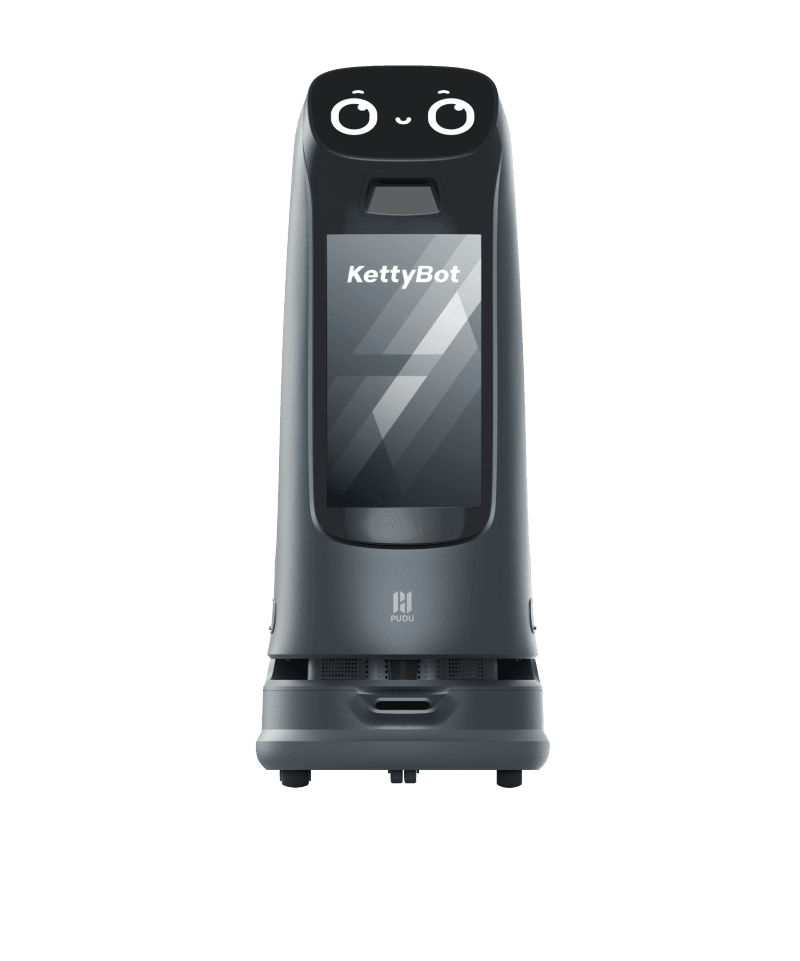
PUDU KettyBot Pro
Premium Advertising and Greeting Robot
Product page- Runtime
- 9 h
- Payload
- 30 kg (10 kg x 3 trays)
- Max speed
- 1.2 m/s
- Weight
- 38
Values are manufacturer data. Scenario fit is determined by comparing these limits with site conditions.
From scenario to installation
Feasibility is determined by the site survey: floor and route, network coverage, the charging point, intervention responsibilities and the conditions under which the robot must stop. The survey report defines the scope, the constraints and the commissioning steps.